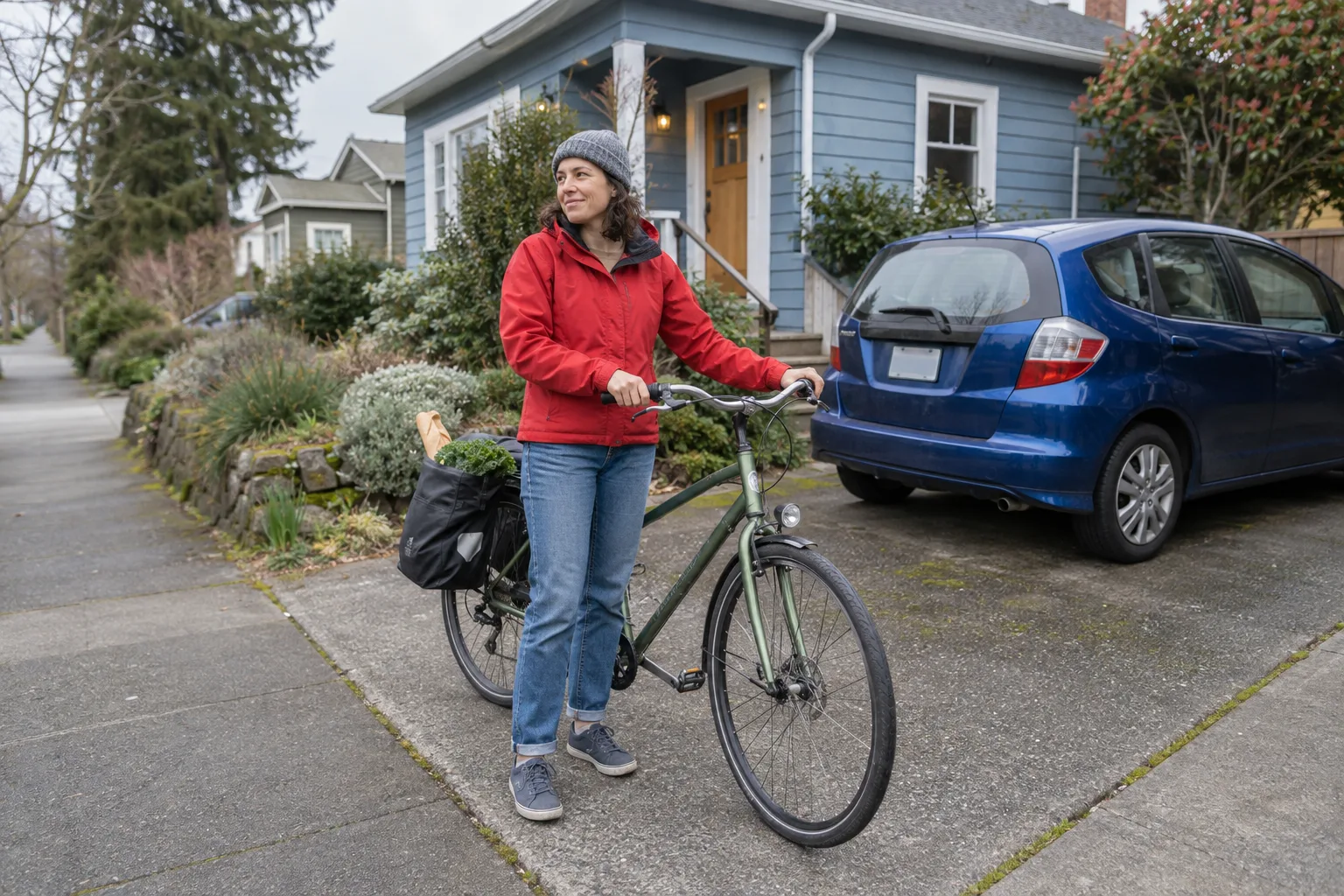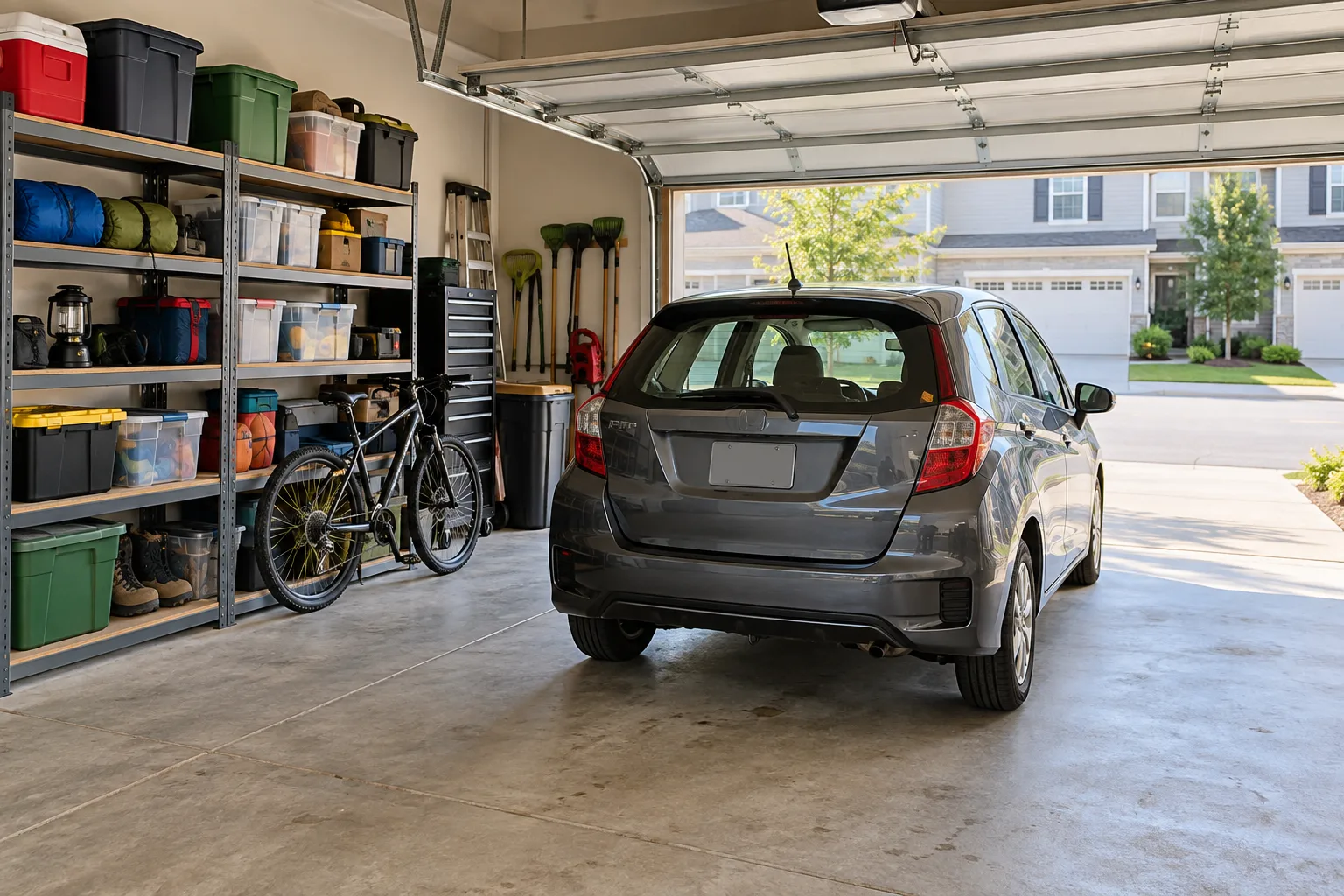
A garage can look spacious with the car outside and impossibly small the moment it comes home. Shelves, bicycles, holiday bins, and the recycling cart all compete for the strip of floor between the vehicle and the wall. Organizing that space begins with the car parked where it normally belongs, not with an empty room.
For an attached garage in a U.S. house or townhouse, the useful question is which daily movements must remain possible. Somebody needs to get out of the passenger door, carry groceries inside, and reach the bicycle without rearranging three unrelated objects. Storage should follow those movements rather than treating every wall as an opportunity to add another rack.
Mark the space that cannot become storage
Park the vehicle and open the doors as they are normally used. Walk from each occupied seat to the house entrance and from that entrance to the outdoor door. Check the garage door’s moving parts and any equipment that needs service access. Those areas define the limits of a storage plan.
The rear of the vehicle matters too. If groceries come through a hatch, leave room to open it and stand behind the car. A bicycle parked in that space might seem harmless until every food shop begins with moving it outdoors. A clear loading area is an everyday use, even when it looks like empty floor.
Do not block the door into the house with temporary donations or parcels. Temporary piles can become permanent because they have no assigned destination. Set an outgoing area somewhere that does not interfere with leaving, and give it a realistic removal date. The exit route should not depend on whether the next charity pickup happens on time.
Put frequency ahead of category
A bicycle used on weekdays needs a different location from a tent used twice a year. Both may be outdoor equipment, but that does not make them good neighbors. The bicycle belongs where it can leave without unloading the shelf; the tent can occupy a less convenient place if its storage conditions are suitable.
Group items around their next use. Garden gloves, a small hand tool, and an empty collection bag may work together near the outdoor door. Car-cleaning supplies may belong in a separate suitable area. Avoid creating one enormous sports zone in which the everyday helmet gets buried behind seasonal equipment.
For households sharing the room, establish who needs which access. A storage arrangement that works for the tallest person may not work for somebody shorter, older, or carrying a child. A lightweight bin is not truly accessible if taking it down requires reaching over the hood. Positioning is as important as labeling.
Choose a shelf for awkward items before buying bins. Folding chairs, spare floor mats, and a stroller may not fit standardized boxes, and enclosing them can make retrieval harder. Some things need a secure open position rather than a container. The aim is a clear room, not an impressive collection of plastic.
Respect what the garage is
An unconditioned garage is not interchangeable with an indoor closet. Temperature, moisture, pests, and exposure vary by region and building. Read storage instructions before putting food, medications, batteries, or sensitive belongings there. A space being dry today does not prove it stays suitable through a humid summer or a freezing winter.
The U.S. Fire Administration’s garage guidance recommends storing oil, gasoline, paints, propane, and varnishes in a shed away from the home and keeping combustible items away from appliances. Treat those recommendations as constraints on the storage plan. Do not design a shelf around keeping hazardous products conveniently beside the door into the house.
If you do not have an appropriate separate storage location, seek product-specific and local fire-safety advice rather than improvising a cupboard. Unwanted chemicals also need the correct disposal route. Contact the local household hazardous-waste program; a general donation box or ordinary trash pickup is not a substitute for its instructions.
A garage with a water heater, furnace, electrical panel, or other installed equipment needs the required access and clearances. Do not cover controls, vents, or labels with hanging organizers. Installation instructions and qualified professional advice take precedence over a storage idea. The room remains a vehicle and utility space even if part of it is used for household belongings.
Choose shelves you can actually use
Freestanding shelves can be useful when a renter cannot alter the walls, but their suitability depends on the product, loading, stability, and any anchoring requirements. Follow the manufacturer’s instructions and the lease. A unit that requires anchoring does not become safe merely because permission to drill is inconvenient.
Keep heavy items at a manageable height and within the shelf’s stated capacity. Do not place an oversized bin on a high shelf because it is rarely used. When that occasion arrives, somebody still has to move it. Divide an unwieldy load or choose a lower location rather than solving the problem with a larger label.
Overhead racks require particular care. They can affect vehicle clearance and need appropriate installation and loading. For many households, a smaller amount of floor-level storage is a better first step than overhead capacity that is difficult to access. Ask whether the rack will free useful space or simply encourage keeping more things.
Before attaching bicycle hooks, check the bike’s weight, the supporting structure, and the lifting involved. A secure floor stand may work better for a heavy bike or for a person who cannot comfortably lift it. Using the available vertical space is only helpful when the household can safely use the resulting arrangement.
Make departures and returns symmetrical
It should be as easy to put something away as to take it out. If returning a lawn chair requires clearing a shelf, it will be left against the wall. Keep the storage opening available even when neighboring items are in place. A good arrangement accommodates the tired return from an outing, not only the energetic departure.
Consider an illustrative household with two bikes, one car, and monthly recycling pickup. Bikes leave from a side zone; recycling waits near the outdoor door; seasonal bins sit at the back. The layout accepts that all three routines happen at different speeds. They do not have to be sorted into equal-looking compartments.
After a week, look at what has landed on the floor. That is evidence about a missing resting place, a difficult return movement, or an object that no longer belongs there. Solve the specific issue rather than repeating the entire cleanout. The garage is organized when the car can come home and everyone can still get where they need to go.