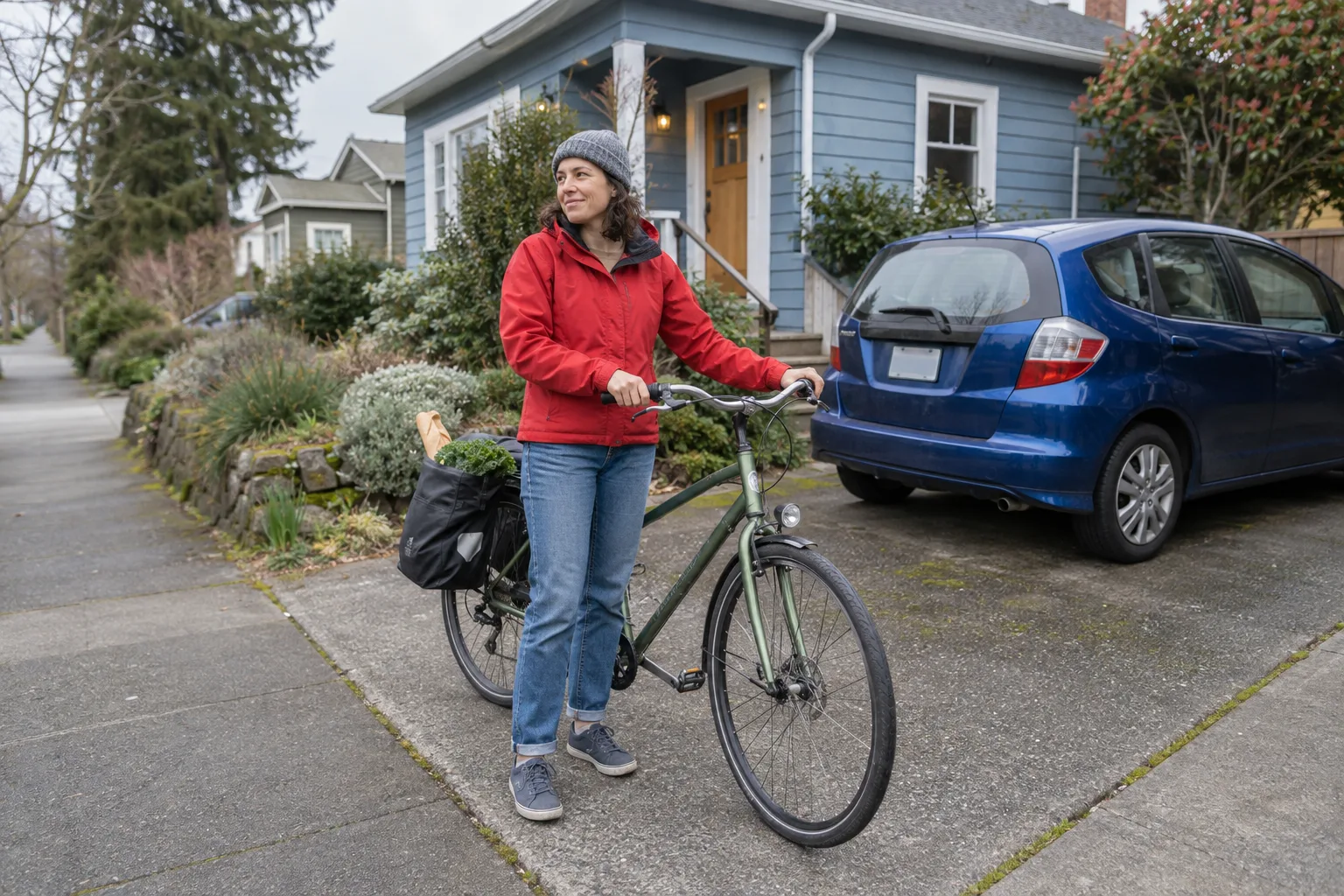
The second car spends most of Tuesday in the driveway. That makes it look expendable, until Wednesday arrives with two work starts, a medical appointment, and a grocery pickup in different directions. Whether a household can manage with one car depends less on the average day than on the days when its plans collide.
Before selling anything, compare a complete week of travel with a realistic replacement arrangement. The aim is to find out which trips need the car, which have usable alternatives, and who would absorb the extra time. A saving that relies on one person becoming everyone else's unpaid driver is not fully described by a smaller insurance bill.
This framework is for U.S. households considering a move from two cars to one. It does not assume that transit, safe cycling routes, ride-hailing, or rental cars are available where you live. Those are possibilities to verify at the places and times you would actually need them.
Map the conflicts, not just the mileage
Write down a normal week's trips for everyone who depends on the vehicles. Include departure and return times, passengers, equipment, and how much flexibility the trip has. A commute with a flexible start is different from a shift that begins at six. A trip carrying a child, mobility equipment, or tools may rule out an alternative that works for an unencumbered adult.
Then add the less frequent obligations: evening classes, weekend work, specialist appointments, visits to relatives, and maintenance visits for the remaining car. You are looking for overlapping claims on one vehicle, including the return journey. Getting someone to work is only half a transportation plan.
A hypothetical household might find that one adult commutes by train on three predictable days while the other needs the car for an early shift. That is a plausible starting point for one-car living if station access and the last train home work. Another household with simultaneous shifts in opposite directions may need two cars even if both commutes are short.
Mark each conflict as resolved, expensive but manageable, or unresolved. Do not fill the unresolved column with “probably a ride.” A ride has a provider, a price, a wait, and a return arrangement. Until those exist, the plan is incomplete.
Check the whole alternative journey
For transit, use the local operator's current timetable and service notices. Check the trip on the correct weekday, at the actual departure time, and again for the return. Include the walk or ride to the stop, transfer time, the fare, and any parking. A route passing near work is useful only if its schedule and stops fit the journey.
For cycling, look at the route rather than converting miles into a hopeful travel time. The National Highway Traffic Safety Administration recommends planning routes with less traffic and lower speeds. Evaluate intersections, lighting, parking at the destination, weather, your own ability, and how any passengers or loads would be carried. An unsafe stretch does not become acceptable because it is short.
A trial trip can reveal practical barriers a map omits. The station entrance might require a longer approach than expected. The bike storage may be inaccessible during your shift. The bus may work in the morning but not after an evening meeting. These are reasons to revise the route or reject it, rather than evidence that you should try harder.
If a disability or health condition affects the options, include the access requirements from the beginning. An alternative is only available if the person making the journey can use it. Do not count a service with unconfirmed eligibility, booking restrictions, or unsuitable operating hours as an automatic backup.
Calculate the costs that would really disappear
The CFPB's car affordability guidance includes insurance, fuel, and maintenance alongside financing. For a two-to-one-car decision, go a step further: separate what disappears when you give up a particular car from what merely shifts to the remaining one.
Some insurance and registration costs may fall, but get an actual revised insurance quote. Fuel savings will be smaller if most trips move to the other car. Maintenance will not vanish either; additional use of the remaining vehicle can create additional expense. Parking only becomes a saving if you can stop paying for that space.
There are two legitimate views of vehicle cost. A cash-flow view records payments and bills. An economic-cost view also considers loss of vehicle value over time. Do not add the full loan payment and depreciation together as if both were separate consumption costs: part of the payment reduces what you owe. Keep the views separate and use the one that answers your question.
For example, imagine a household with a fully paid-off second car. The following invented amounts illustrate monthly cash planning, not national averages or quotes:
| Change | Monthly amount |
|---|---|
| Insurance saving confirmed by a revised quote | $95 saved |
| Registration and inspection allocation | $15 saved |
| Maintenance reserve for the second car | $70 released |
| Net fuel reduction across the household | $60 saved |
| Transit and occasional rides | $90 added |
| Extra maintenance reserve for the remaining car | $20 added |
| Net monthly planning difference | $130 less needed |
The arithmetic is $240 removed minus $110 added. Over a year, the modeled difference is $1,560. Reserve allocations are money set aside rather than guaranteed bills each month; repairs can be uneven. The calculation excludes depreciation, sale proceeds, and any one-time transaction costs. If occasional rides cost $100 more than planned, the monthly difference falls to $30.
That sensitivity matters. A plan with a modest saving may still be worthwhile for a household that dislikes maintaining two cars. It may be a poor trade for another household that would lose hours every week. Put the time change beside the money instead of declaring the cheaper column the winner.
Keep the sale separate from the monthly budget
If the car has a loan, request the current payoff amount and establish the steps required to transfer it lawfully with the lender and your state's motor vehicle agency. Compare realistic sale proceeds with the payoff and transaction expenses. If the proceeds do not cover what must be paid, the gap needs funding; selling does not erase it.
For a paid-off car, sale proceeds can provide a reserve. They are not recurring income. Decide how much would remain available for replacement transport, repairs to the remaining car, or a later change of plan. Spending the entire amount elsewhere can make a failed trial expensive to reverse.
Also compare which vehicle to keep. Reliability, passenger needs, accessibility, cargo space, running costs, and financing can point in different directions. The newer car is not automatically the right one, and the lower monthly payment does not describe the entire obligation.
Run a trial that includes an inconvenient week
Keep the second car available but avoid using it for a defined trial, perhaps several ordinary weeks long enough to include recurring commitments. This is a practical experiment, not a requirement to endanger anyone or miss essential care. If the plan fails, use the car and record why.
A mild-weather trial cannot establish whether the same routes will work through winter or extreme heat. Add a separate seasonal plan for the trips that would change, using local conditions and your own limits. Likewise, school breaks can alter both travel and childcare arrangements. If a month of extra rides or a temporary rental would be necessary, include that annual expense before spreading the savings across twelve months.
Track actual spending, waiting, extra driving, and canceled activities. Ask each person whether the arrangement felt workable. Someone who quietly stopped visiting friends may have solved the calendar conflict by giving something up; that belongs in the result.
Build a backup for the remaining car being unavailable. Check rental pickup hours, ride availability, suitable child seats where needed, and what happens if the disruption lasts several days. Friends and relatives can be part of the plan only if they have genuinely agreed and can provide the help.
At the end, one car is a sound option when the essential journeys work, backup costs fit the budget, and the distribution of effort is acceptable to everyone involved. If a recurring conflict remains unresolved, keep the second car for now or revisit the decision after a job, route, or schedule changes. The driveway can contain a useful vehicle even when it is empty of activity most Tuesdays.