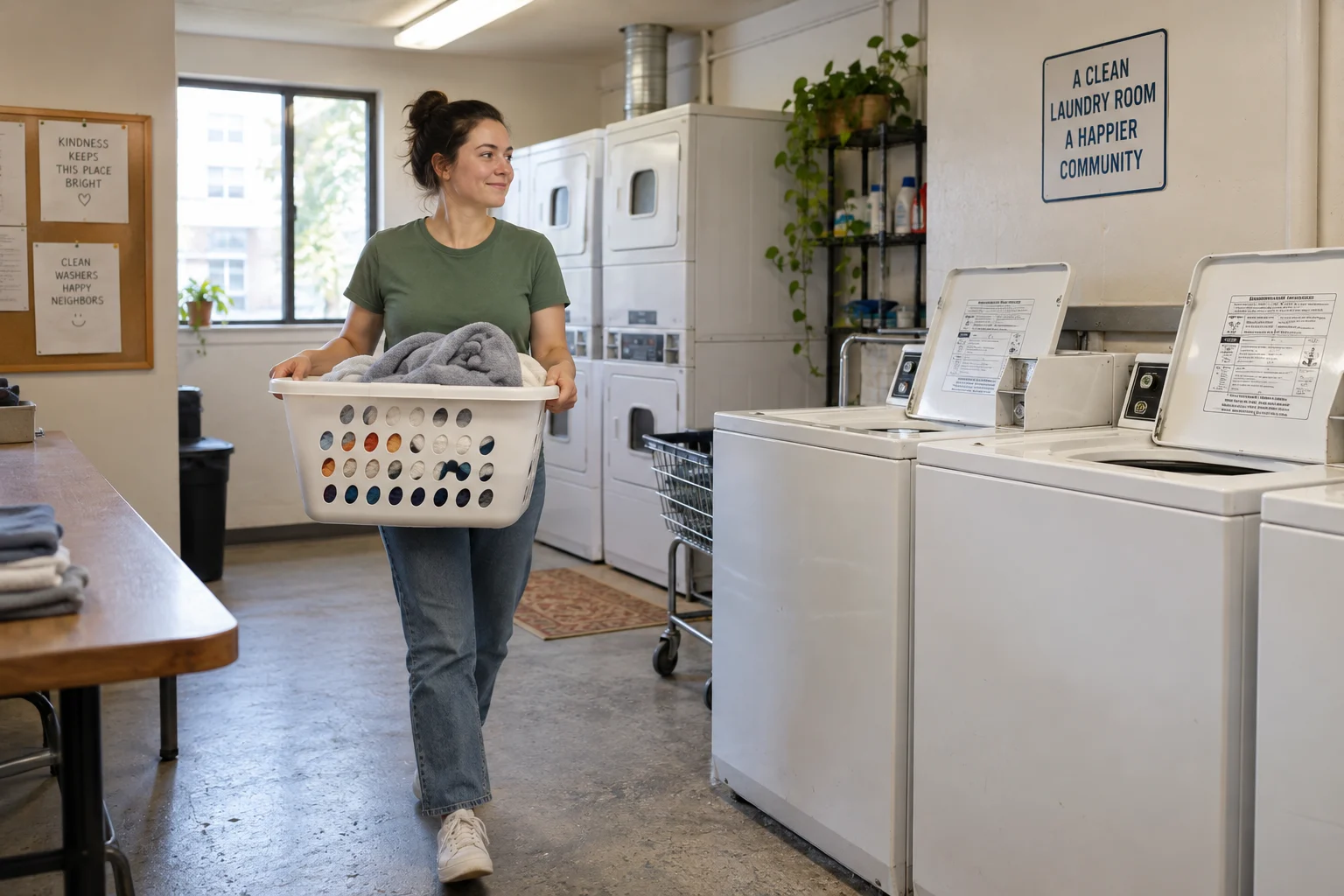
A laundry room in the building sounds convenient until all three washers are occupied and the payment app wants another login. You still have the bag in your hand, the wet weather outside, and a limited stretch of time before work. The question is not whether shared laundry is inherently good or bad. It is how much of your week this particular arrangement consumes, and what would make it easier to use.
U.S. apartment listings can compress very different setups into the words “laundry available.” Machines might be inside the building, across a courtyard, in another complex, or simply somewhere nearby. Before signing a lease, or while improving a routine in your current place, trace the complete trip from the hamper to clean clothes back in the closet. That is the service you are actually using.
Look at access before counting machines
Start with opening hours, the route, and the door. A basement room reached by stairs presents a different task from an elevator-accessible room on your floor. Check whether you need a key, app, card, or cash, and whether you can enter with a loaded basket without putting it down in the rain. If you use mobility equipment, assess the actual route and machine controls rather than accepting a general description of the building.
Ask how broken equipment is reported and who handles refunds. Find out whether a machine's displayed availability can be trusted and whether posted hours include enough time to finish a drying cycle. These are practical operating questions, not demands for special treatment. A laundry room with fewer working machines than advertised can change the time calculation substantially.
At a laundromat, include the journey home. Parking beside the entrance in the morning does not tell you whether you can load the car during a busy evening. If you walk or take transit, consider the weight of the return trip, especially when clothes are not fully dry. The distance is only one part of the effort; carrying, waiting, and crossing streets are part of it too.
Work out what a week really costs
Record an ordinary week before deciding that a different machine or larger load will save money. Count wash cycles, dryer time, transport, detergent, and any payment fees you actually incur. Keep occasional bulky items separate from your regular clothing. Otherwise, a week with bedding and winter coats can make your usual routine look more expensive than it is.
Here is a hypothetical comparison, not a local price quote. Two weekly washes at $3 each and two drying sessions at $2 each cost $10. Over four weeks, that is $40 before supplies or travel. If a farther laundromat saves $2 per visit but requires a $5 round trip, it does not reduce cash spending. It might still offer machines that handle your bedding or hours that fit your work, which are separate reasons to choose it.
Avoid buying a large stock of supplies just to make the per-ounce price look lower. Storage and carrying capacity matter in a small rental. A container you can lift, measure, and transport without leaking may be more useful than the cheapest bulk package. Follow the product and machine instructions; more detergent is not a substitute for selecting the right cycle.
Separate the jobs that need different treatment
Read garment labels before sorting only by color or convenience. Some items cannot share the heat or handling that suits the rest of the load. Put those aside before leaving the apartment so you are not making the decision while occupying the only folding table. Keep a small bag for items that should not enter the dryer, and check it before transferring clothes.
The Department of Energy's household laundry guidance includes washing with cold water where appropriate, running full loads, and cleaning dryer lint screens. Apply those suggestions alongside fabric labels and the machine's instructions. “Full” does not mean compressing every available garment into a drum that can no longer move its contents properly.
If air drying is part of your plan, give it a real place at home. A folding rack can work well if it does not block movement or leave the only chair unusable. Think about airflow, drips, and the surface underneath. Check rental rules for balcony use rather than assuming that the railing is a clothesline. Drying space is part of the laundry system even when no money changes hands.
Use a time window you can actually keep
A promising strategy is to try one different time slot, not redesign your whole week. If Saturday mornings are crowded, test an evening that fits your schedule and record how long the complete trip takes. A quieter hour is only useful if it does not cost sleep, childcare, or an awkward journey home. Someone else's ideal laundry time may be impossible for your household.
Set a reminder for the expected end of the cycle and allow for getting back to the room. Follow posted rules about unattended clothes and finished loads. Do not treat another person's belongings as disposable obstacles, and do not assume every neighbor can reach the machine immediately. If recurring conflicts make the room difficult to use, ask management for a clear shared policy rather than inventing one during an argument.
In a shared household, divide more than the carrying. One person may start the machines while another folds, checks supplies, or puts clothes away. Make the arrangement explicit enough that the invisible parts do not always return to the same person. A completed wash is not a completed task if clean clothes sit in a bag until someone else sorts them.
Know when a different arrangement is worth paying for
Wash-and-fold services, pickup options, or a different laundromat may be useful during a demanding period. Compare their actual terms: how items are counted, what is excluded, turnaround time, fragrance preferences, and responsibility for delicate pieces. Do not send something irreplaceable merely because the service describes itself as convenient. Read the handling policy first.
You might choose a paid service only for bulky bedding, after travel, or during a temporary change in care responsibilities. That does not require adopting it for every load. The useful comparison is between the money spent and the specific burden removed. If your ordinary laundry routine is manageable but one oversized comforter causes trouble, solve the comforter problem. There is no need to buy a new weekly routine around one difficult item.