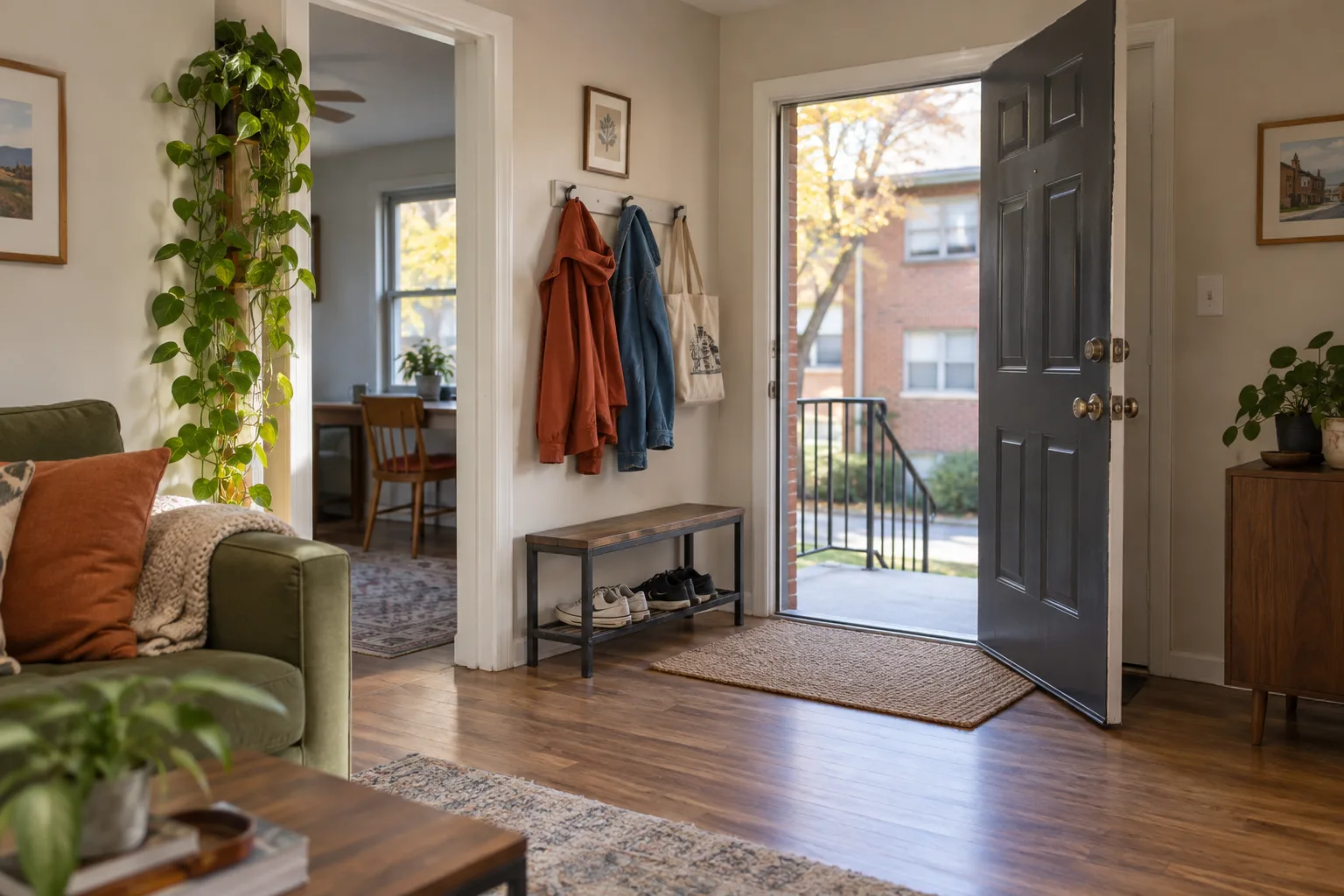
The front door opens, and you are already in the living room. There is no hallway to absorb a wet jacket, no coat closet beside the threshold, and no obvious place to put a bag without putting it on the couch. Adding an entryway table sounds sensible until the table becomes the thing you have to squeeze past.
This is a space-planning problem before it is a storage problem. An entrance needs to let you arrive, put down what you are carrying, and move farther into the home. Those jobs do not have to happen against the same wall. In a small rental, separating them can work better than buying a matching bench, rack, and mirror that collectively occupy the only clear route through the room.
Start with what happens during an ordinary arrival. If you usually come home with groceries, a shoulder bag, and shoes you want to remove, the first useful surface might be within reach of the kitchen rather than directly beside the door. The right location is the one you can use while your hands are full.
Watch the door before choosing the furniture
Open the front door fully and look at the space it actually needs, including the handle. Then open nearby closet doors and pull out the dining chair closest to the entrance. A spot can look empty while every piece of the room is at rest and become unusable the moment someone moves through it.
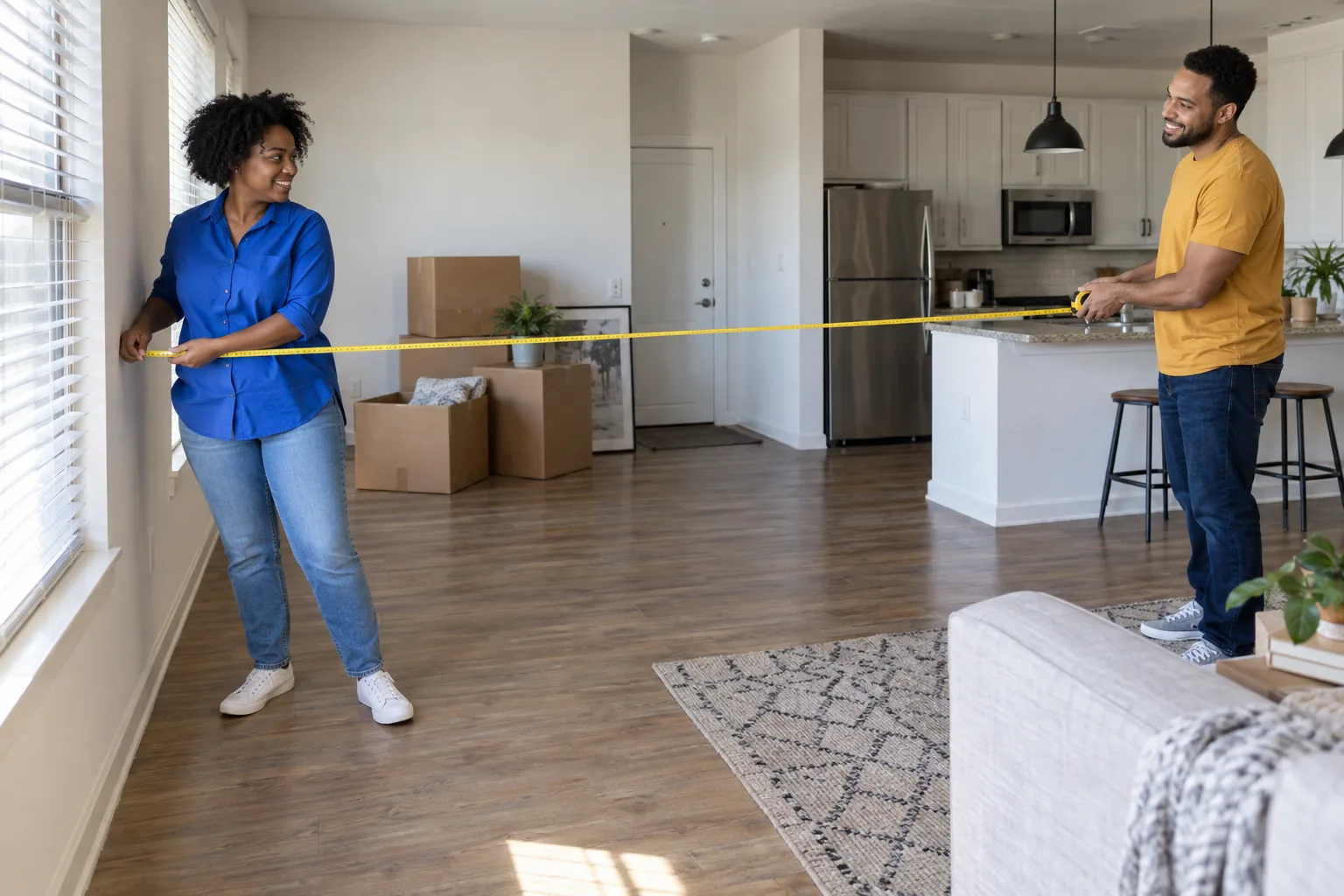
Mark a possible furniture footprint with removable painter's tape, testing the tape on an inconspicuous surface first. Walk past it carrying your largest grocery bag. Repeat with anyone who shares the home, using whatever mobility equipment they normally need. Do not turn a comfortable route into a sideways shuffle simply because a narrow cabinet fits on paper.
Consider an illustrative apartment where the door opens along the left wall and the kitchen counter begins several steps to the right. A bench behind the door interrupts its swing. A tall rack opposite it crowds the path to the kitchen. The better arrangement might be a shoe tray farther along the left wall, a small landing space on the counter, and coats in a bedroom closet. That is still an entrance system. It just does not resemble a furniture-store display.
Keep the exit usable and leave building equipment, vents, and electrical panels accessible. The shared hallway outside the apartment is not spare indoor storage; check building rules before placing anything there. Solving your own doorway should not move an obstacle into someone else's route.
Give the first minute fewer decisions
A landing place only needs to hold the things that arrive together. For one person, that might mean keys and a wallet. For another, it includes a work badge, headphones, and a bag containing medication that needs appropriate storage elsewhere. Design around that actual collection rather than an imagined household with one key and no mail.
A shallow dish can reserve a corner of an existing shelf without claiming the whole surface. A bag can have a dedicated shelf or a suitable hook. Shoes can sit on a washable tray, provided it stays out of the walking route. These are different jobs, and trying to make one tiny basket do all of them usually makes the smallest item disappear beneath the largest.
Mail deserves a separate decision. If the entrance becomes its permanent home, keys will eventually share a pile with unopened envelopes. Choose a place to review it, even if that place is the dining table later that evening, and keep only a small temporary holding space by the door. A decorative organizer with six compartments is unnecessary when the missing step is opening the mail.
In a shared apartment, individual landing spots can be more useful than a larger communal container. They make it clear whose sunglasses are where without requiring everyone to organize belongings in the same way. Put those spots at heights their users can comfortably reach.
Store today's things near the door
The entrance does not have to hold every coat and every pair of shoes you own. If space is tight, distinguish between what is in current use and what needs longer-term storage. Everyday shoes belong near the route in and out; occasional footwear can live elsewhere. Seasonal gear should not claim the best position during a season when nobody wears it.
That distinction is especially helpful when a household's needs differ. One person may need work boots and a rain jacket every day while another needs a place for a gym bag. Equal numbers of hooks are less important than giving each recurring item a workable destination.
Wet items also need somewhere appropriate to dry. Packing a damp jacket into an already full cabinet may hide it, but it does not make the arrangement useful. Allow room around hanging clothing and use a tray or mat suitable for the floor beneath it. Follow care instructions for both, and check underneath rather than assuming a waterproof surface protects every finish.
A bench earns its footprint when someone regularly sits to change shoes. If nobody does, a compact shoe solution may be enough. If sitting matters, choose something designed to support a person; an improvised shelf is not automatically a seat.
A rental-friendly solution still needs to be secure
Check your lease and get permission where required before drilling or making changes. Removable hooks have specific surface and weight limits, so read the manufacturer's instructions and allow for the actual loaded bag, not just its empty weight. Do not use adhesive hooks as substitutes for furniture safety hardware.
The Consumer Product Safety Commission recommends securing furniture against tip-over. Follow the furniture manufacturer's anchoring instructions, using hardware appropriate for the wall. If a unit needs anchoring and you cannot obtain permission or install it correctly, choose a different solution instead of leaving it unsecured.
A freestanding coat rack also needs a realistic load test within its instructions: several heavy bags on one side are a different proposition from the light scarf shown in a product photo. Storage should remain stable when used normally, including by children in the household. Keep small objects and other hazards out of their reach.
There is no obligation to build vertically just because a wall is available. A lower, simpler arrangement can preserve both sightlines and room to move. The entrance already has an important architectural feature: the door.
Try the arrangement before completing the look
Use an existing chair, tray, or shelf to test the locations before buying dedicated furniture. Run the arrangement through a working week and a grocery trip. Notice where items still land, which door becomes awkward, and whether putting things away requires a detour nobody actually takes.
If the bag keeps returning to the couch, move its landing place closer to that route. If the shoe tray overflows, decide whether it needs more capacity or whether it is holding shoes that could go elsewhere. These are different fixes. The first changes the container; the second changes what the entrance is being asked to store.
Only then decide whether the space needs a lamp, color, or a mirror. A small entrance can have personality without becoming crowded: a patterned washable mat, an existing bowl, or one jacket in a color you like may already do the work. When the door opens freely and you can come home carrying something, the important part is finished.