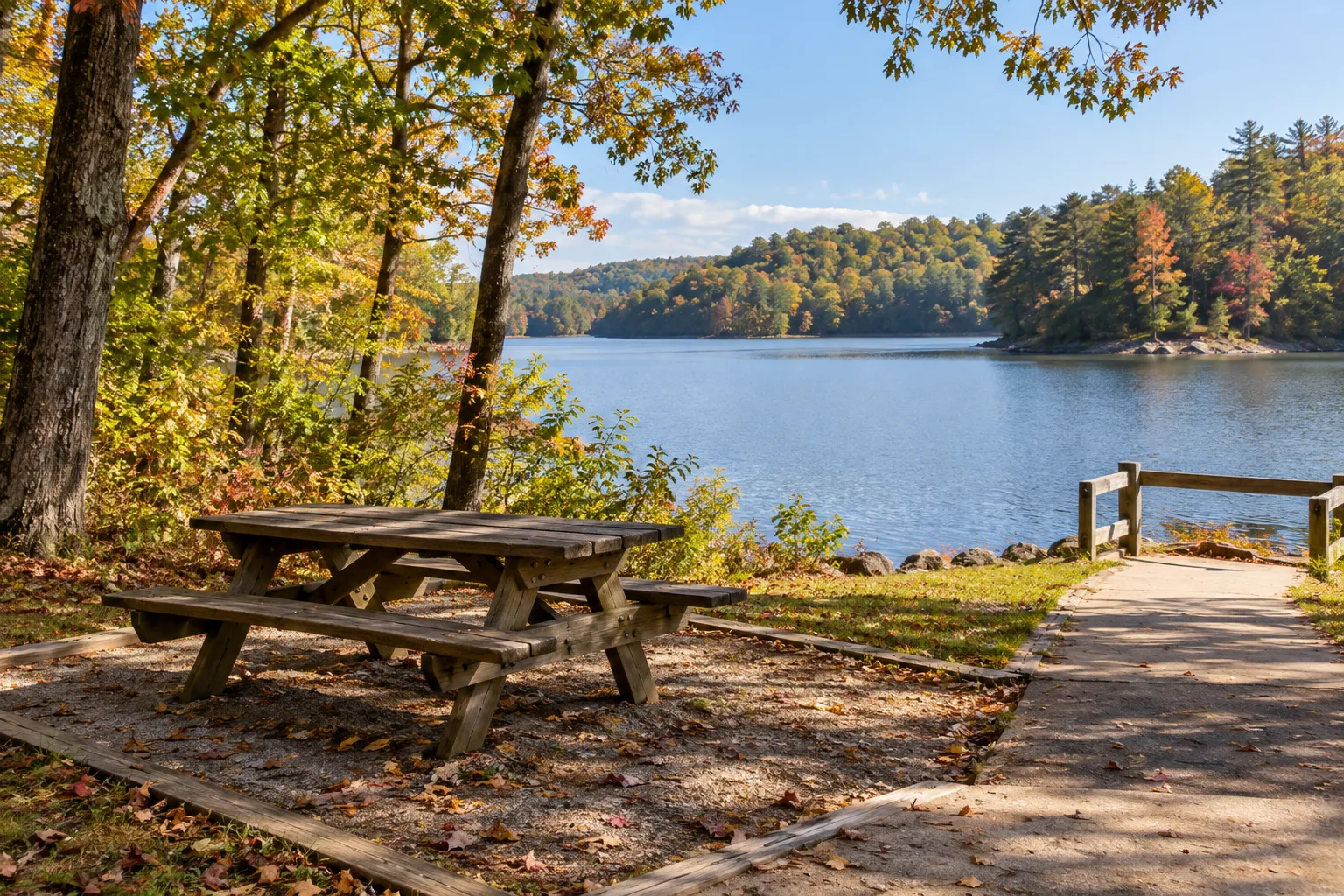
A state-park day trip can be more satisfying than a weekend spent racing between famous viewpoints. You have time to sit by a lake, walk a manageable trail, eat something you brought, and return home without unpacking a car full of camping equipment. The plan still needs more than choosing a green patch on the map.
State parks belong to different state systems, and the rules are not interchangeable with national parks or national forests. Start with one park and one reason to go. A short waterside walk, a picnic, or a quiet afternoon outdoors is enough. The park does not need to supply every activity on its brochure for the visit to be worthwhile.
Pick the experience before the name
Decide what you want to do and who is coming. A group seeking a paved lakeside route needs a different park from hikers wanting a steep overlook. A beach visit depends on different facilities from a woodland picnic. The park’s reputation matters less than whether the actual day-use area supports the visit.
Read the official park page and map. Identify the entrance closest to the activity, the parking area, the available route, and any facilities essential to the group. A large park may have several disconnected areas, and the address suggested by a general map app may lead somewhere other than the picnic site you intended.
For accessibility, look for details about the specific route or facility rather than relying on a general symbol. Surface, slope, distance, and available seating can make a difference. If the published information leaves an essential question unanswered, contact the park before the trip. A short route is not automatically an accessible route.
In an illustrative visit, two friends want an hour outdoors followed by lunch. A nearby park with a modest path and picnic area may serve them better than a more celebrated park with a long approach to its main viewpoint. The shorter journey preserves the time they actually wanted to spend there.
Establish which permission belongs to this place
Check day-use fees, passes, reservations, and any separate requirements for the activity. Do not assume that an annual federal recreation pass covers a state park. The agency managing the land determines the relevant system. A pass can also have exclusions or fail to guarantee space at a busy site.
For a concrete state example, Washington State Parks explains its Discover Pass arrangements. In California, State Parks’ fee FAQ describes day-use charges and the California State Library Parks Pass for participating parks. These are examples of different systems, not two versions of a nationwide rule.
If you have a pass, verify that it applies to the particular park and intended activity. If borrowing one from a library, check availability, loan timing, participating sites, and any limits. A useful benefit still needs to be obtained before departure; it cannot solve access at the gate if the borrowed pass is at another branch.
Read any reservation confirmation carefully. A parking reservation, campsite booking, or picnic shelter reservation may cover different things. Record the arrival window and cancellation terms where relevant. Paying for one facility does not establish that every other service is included.
Build the day around usable time
Work backward from when you need to be home. Include the drive or transit journey, entrance process, parking, the route from parking to the activity, and a return buffer. A park an hour away does not necessarily provide four outdoor hours within a six-hour window.
Check the opening and closing arrangements for the specific day-use area. Parkland being visible on a map does not mean the vehicle gate remains open indefinitely. Leave enough time to return to the correct parking place and exit under the posted rules. Sunset is not a substitute for the park’s schedule.
If using transit or a shuttle, check both directions and the distance between the stop and the activity. A bus serving a nearby town may not serve the park entrance. Plan the last dependable return connection before you choose the outbound departure. The walk back is part of the outing, not something to discover afterward.
Bring the basics the site may not provide
Check whether drinking water, toilets, picnic tables, and food services are available and operating. Even a developed park can have seasonal closures or a particular day-use area without the facilities shown elsewhere on the park map. Bring what the trip depends on rather than assuming a concession stand will be open.
Choose food suited to the visit and handle it safely. The FDA’s outdoor-food guidance explains cold storage and safe holding times. If food requires refrigeration, a warm car is not appropriate storage while you complete a long walk. A simple picnic that can be managed safely is preferable to an elaborate meal with no workable storage plan.
Bring clothing and footwear appropriate to the route and forecast, along with enough water and any personal necessities. Download the relevant map if reception is uncertain. Avoid planning an unfamiliar walk around the expectation that mobile directions will always be available.
For dogs, check the park’s rules and permitted areas. A park allowing pets in a campground may have different restrictions on a beach, building, or trail. The same applies to bicycles and other activities. The question is where the intended activity is permitted, not whether the park mentions it somewhere online.
Have a smaller version ready
Review official alerts and weather before leaving. If heat, storms, smoke, closures, or other conditions undermine the plan, choose another activity or postpone. Having already packed lunch does not make the original route sensible.
Within suitable conditions, keep a shorter option. A picnic and brief walk can still be a good day if the group has less energy than expected. Agree that possibility before the trip so nobody has to defend a shorter outing after reaching the park. The person who planned the visit need not personally deliver every mile of walking.
The useful state-park trip ends with enough energy for the journey home. One place, an understood access arrangement, and a realistic amount of time can provide a full afternoon. A quiet bench beside the water does not become more worthwhile because you managed to add two other stops.