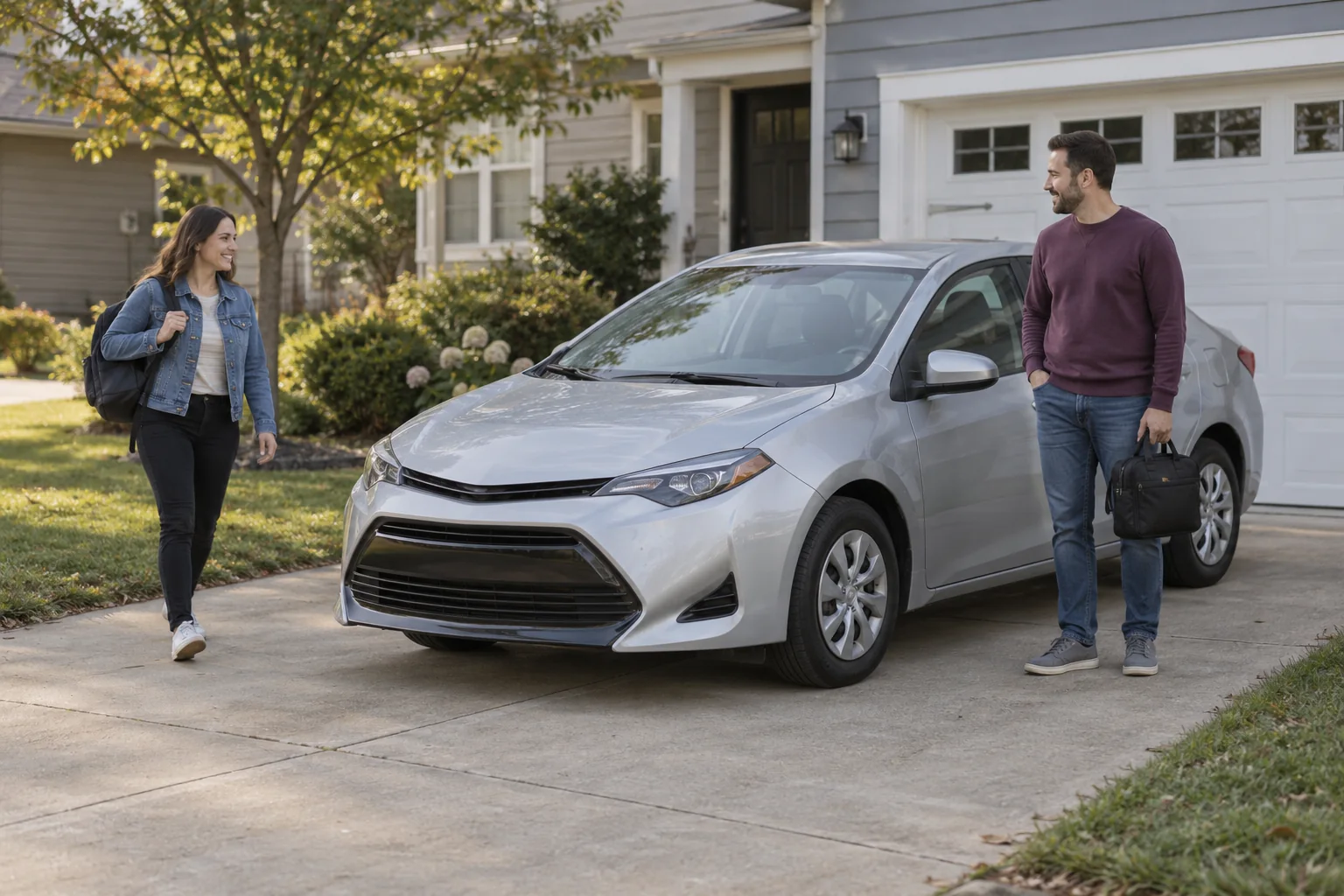
Two coworkers live near each other and arrive at the same building. Sharing a ride seems obvious until one starts early, the other needs to leave at five, and the easiest pickup adds a detour neither included in the original calculation. A workable carpool needs more than nearby addresses.
Start with the trips you can reliably share, even if that is only two days a week. Then agree on pickup, departure, costs, and what happens when someone cannot participate. The arrangement should reduce the burden of commuting without making one person responsible for everybody else’s entire day.
Match the return trip first
Morning schedules can look compatible because everyone aims to arrive around the same time. The return often reveals the real differences. One person has a fixed shift, another regularly stays late, and a third needs to collect a child. A common destination does not make those departure times interchangeable.
Compare actual schedules for a normal week. Identify days when both the morning and return trips align. If only the morning works, decide whether sharing that one direction is still useful and establish how each person gets home. Do not leave the unmatched leg as an optimistic detail.
A hypothetical pair shares Tuesday and Thursday because both have predictable office hours then. On Monday, one has a recurring late meeting; on Friday, the other works elsewhere. Two dependable shared days may remove more hassle than a five-day agreement that needs renegotiation every morning.
If your employer describes a role as hybrid, confirm the actual attendance pattern. Our article on what a hybrid schedule really means explains why a broad label does not establish which days people need to travel. Build the carpool around the schedule you have, with a plan to revisit it if that changes.
Choose a pickup that is fair in both directions
A doorstep pickup is convenient for the passenger and may be a substantial detour for the driver. Map the extra distance and time rather than calling it nearby. A shared meeting point can work better if both people can reach it comfortably and use it lawfully.
If the meeting point involves leaving a car, verify parking permission, hours, and any restrictions. A shopping-center lot is not automatically a commuter lot. Check lighting, the route on foot, and what the location will be like at the return time as well as in the morning.
Agree on the departure time and what waiting means. A small grace period may be practical; an undefined one can make the person who is ready on time late for work. Decide how someone reports a delay and when the others should leave. Keep messages and schedule changes out of the driver’s hands while the vehicle is moving.
For people meeting through a matching service rather than existing coworkers, begin with a conversation in a public setting and establish who is participating. You can decline an arrangement that does not feel comfortable. The fact that routes match does not oblige anyone to share a vehicle.
Make the money arrangement explicit
Rotating drivers can be straightforward when the journeys and vehicles are reasonably comparable. It is less straightforward when one person always drives, one pickup requires a large detour, or only one vehicle can carry everyone. Discuss the actual arrangement instead of assuming equal turns will somehow emerge.
For a simple hypothetical example, suppose a shared day involves $18 in agreed fuel costs and $12 in parking, with three participants. Splitting those two costs equally gives $10 each. That is a model calculation, not a current local price or a complete estimate of vehicle ownership costs.
The group still needs to decide whether and how to account for wear, additional mileage, or other costs. There is no single amount implied by the example. Avoid silently using a reimbursement figure from an unrelated context as though it automatically defines a fair private arrangement.
Agree on payment timing and what happens when someone cancels. A contribution per shared day may suit an occasional carpool; another arrangement may suit fixed commitments. Write down the choice so a missed week does not become an argument about something everyone remembers differently.
Before starting, the vehicle owner should describe the proposed arrangement to their insurer, including any contributions and who may drive, and confirm the relevant coverage. Do not assume a casual shared commute and a paid driving service are treated identically. The answer needs to come from the policy and provider, not the group chat.
Plan for an ordinary bad day
Someone will eventually be ill, work late, or need to leave unexpectedly. Identify realistic alternatives before the shared ride becomes essential: transit that operates at the necessary time, a taxi or ride service you can afford, another agreed lift, or a household vehicle arrangement.
Some regions have emergency ride-home programs with eligibility conditions. For example, the Washington, D.C., area’s Commuter Connections Guaranteed Ride Home program supports qualifying commuters in specified circumstances. Check its current participation and registration rules if relevant to you; it is not a nationwide promise or a substitute for checking your own local options.
Separate an emergency from a routine late finish. If someone regularly works beyond the agreed departure, the carpool may need different days or a one-way arrangement. Repeatedly asking the whole group to wait is changing the agreement, even if every individual delay has a reasonable explanation.
The driver also needs a way to cancel without becoming responsible for everyone’s replacement ride. Give as much notice as possible, but keep a backup that each participant understands. A shared commute is more sustainable when participation does not mean being permanently on call.
Try a short, defined period
Agree to test the arrangement for a couple of ordinary weeks, then compare what happened. Count the driver’s detour, the passenger’s trip to the pickup, parking time, and any waiting. The benefit should be judged across the whole group, not solely by the fuel bill.
Talk about the small things too: conversation, quiet mornings, music, eating, scents, and temperature. You do not need a formal code of conduct. A few clear preferences are easier to work with than expecting strangers or coworkers to share the same idea of a comfortable car.
Leave an easy way to stop or reduce the arrangement. Someone’s schedule may change, or the shared trip may simply not suit them. Being able to say that without damaging a work relationship is part of a sensible trial. If Tuesday and Thursday work well, keep Tuesday and Thursday. You can make separate arrangements for Monday without giving up the days that work.