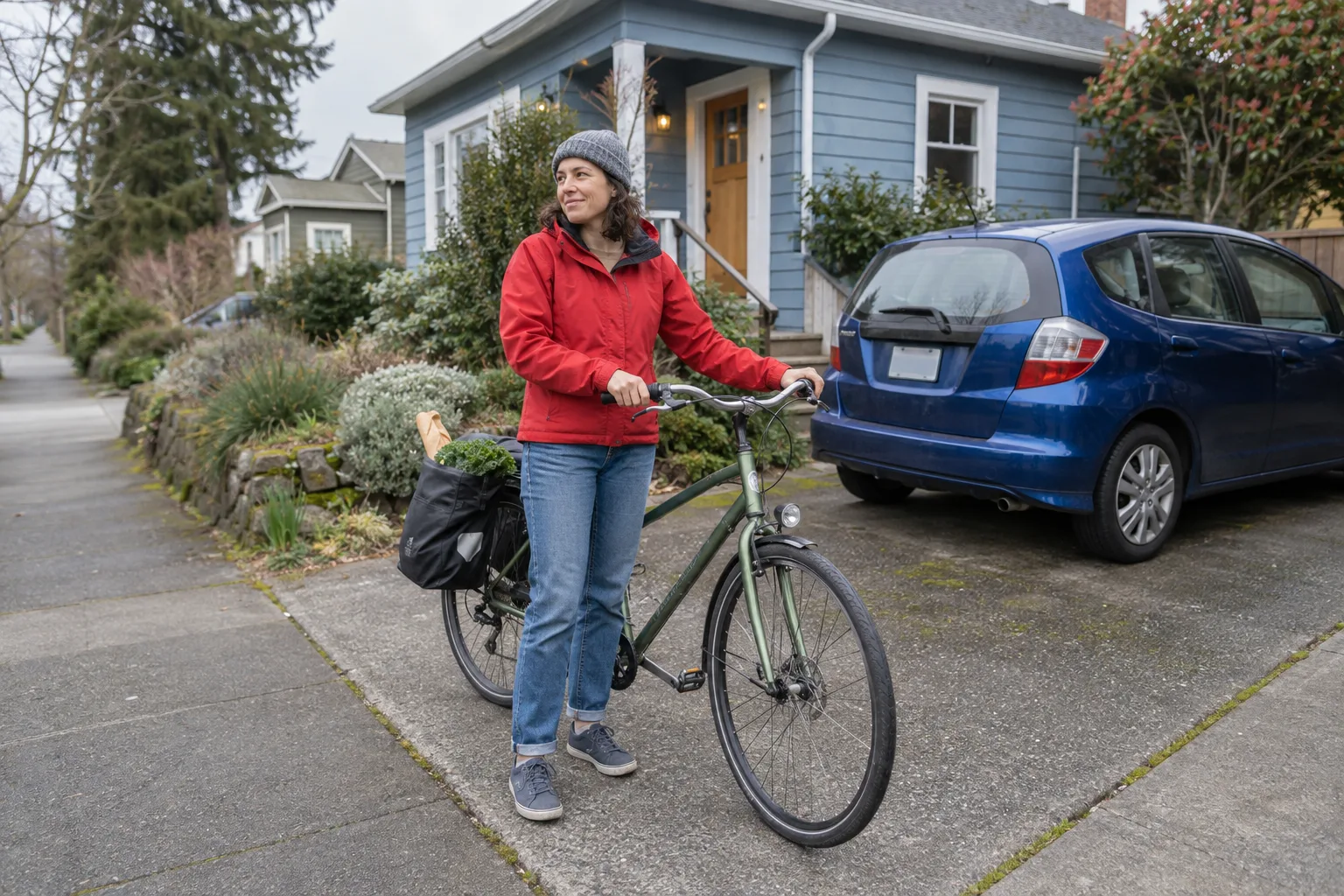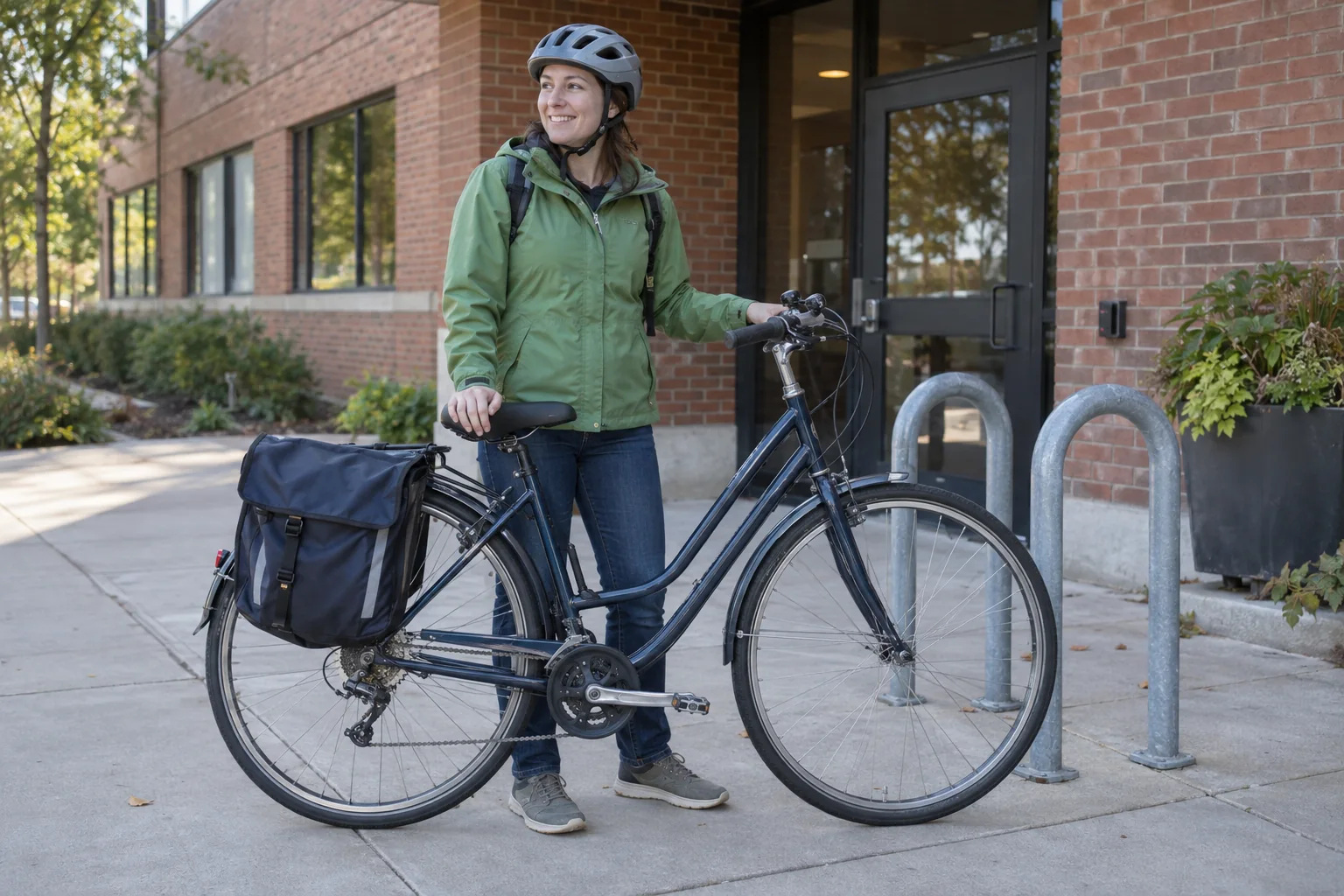
You do not have to become a person who bikes to work every day. You can start by finding out whether one ordinary workday is better with a bicycle in it. That smaller question makes room for a practical trial instead of an identity, a shopping list, and a promise to ride through every season.
The complete commute includes getting the bicycle out, following a suitable route, parking it, changing if necessary, and getting home. A short distance on a map does not settle those details. Neither does an impressive weekend ride. Test the actual sequence on a day when you have room to adjust.
Choose the route before the equipment
Start by looking for a route you would be comfortable using in both directions. The route you drive may be unsuitable for a first bicycle commute. A slightly longer alternative can be preferable if it avoids a difficult junction or a fast road, but inspect the whole connection rather than assuming a green line on a map guarantees continuity.
Pay particular attention to the beginning and end. A pleasant path that stops beside a complicated intersection can leave the hardest part immediately before work. Look at how you reach the path, leave it, and enter the destination. Check local rules where the route includes sidewalks, shared paths, or other restricted spaces.
The NHTSA bicycle safety guidance recommends planning around lower traffic and slower speeds, using a bicycle that fits and works, and wearing a properly fitted helmet. It also addresses lights and reflectors for darkness or poor visibility, predictable riding, and observing traffic controls. Read that guidance before the trial; route convenience is only one part of the decision.
Try unfamiliar parts when you are not racing a work start time. A weekend check can reveal confusing turns and access problems, although weekday traffic may be different. If a section feels beyond your current skills, choose another route, seek appropriate instruction, or keep another transport option. Discomfort is information, not a challenge you must accept.
Visit the place where the bicycle will wait
Ask where you can park and what access is available during your actual hours. An indoor room may require a badge or permission. An outdoor rack may be farther from the entrance than expected. You want to discover those details before arriving with a meeting about to start.
Check the entire arrival process: where you dismount, how you reach the parking, what you can lock to, and whether the location works for your bicycle. Bring an appropriate lock and follow its instructions. A convenient spot is not automatically a secure one, and no arrangement makes theft impossible.
Storage at home deserves equal attention. Carrying a bicycle down several flights of stairs can become the most awkward part of a short ride, especially with a bag attached. Time that movement and make sure the resting place does not block a shared passage or exit.
If the workplace provides showers or lockers, establish when they are accessible and whether you need to reserve or register. If it does not, consider whether the distance, pace, weather, and your clothing requirements allow a comfortable arrival. There is no need to pretend those constraints disappear because the route is short.
Carry what the day requires
For the first attempt, reduce unnecessary cargo without leaving essential work items behind. A securely attached bag or an appropriate backpack can be enough. Test it before the commute so you know whether it shifts, catches, or changes how the bicycle handles. Do not begin by hanging a loose shopping bag from the handlebars.
Clothing depends on the ride and the job. Some people can travel in ordinary clothes; others need a change. You might leave shoes or a clean outfit at work beforehand if there is a suitable place. That can simplify the first trial without requiring a complete set of specialized equipment.
A bicycle that has been sitting unused should be checked before relying on it. If you cannot assess its condition confidently, have a qualified bike shop inspect it. Buying a pannier before discovering a brake problem puts the decisions in the wrong order.
Choose a modest pace and allow time to arrive. The trial is about whether the journey works, not the fastest time you can record. Rushing can conceal useful information, such as the extra minutes needed to lock up or the crossing where you prefer to wait for a calmer opportunity.
Count the whole trip honestly
Consider a hypothetical commute with a 25-minute ride, five minutes to retrieve the bicycle and leave home, and ten minutes for parking and changing. The door-to-ready-for-work total is 40 minutes. Comparing the ride alone with a 35-minute drive-and-park routine would give the wrong impression.
That does not make the bicycle the worse choice. You might prefer the journey, value avoiding parking, or find the schedule more comfortable. It simply means the decision should use comparable totals. Include the walk from the car or transit stop in the alternative, too.
Check the return separately. Traffic, daylight, weather, and energy may all differ after work. A morning that feels straightforward does not guarantee an equally comfortable evening. If the workday can end late, include that possibility when deciding which days to ride.
For a household considering using one car instead of two, several successful bicycle trips are useful evidence. They are not yet proof that the car can disappear. School pickups, appointments, and days when riding is unsuitable still need an arrangement.
Give the experiment an exit
Decide what you will do if the bicycle develops a problem or you cannot ride home. A transit option is only a backup if its route, hours, and bicycle policy fit the situation. A ride from someone else is only a plan if that person has agreed and the bicycle can be dealt with.
You might arrange to leave the bicycle securely at work and collect it later. That depends on permission and storage access, so establish it beforehand. The alternative should not require improvising with an exhausted colleague in a parking lot.
After the trial, change one awkward part before repeating it. Perhaps the route needs a different turn, the bag needs adjustment, or arrival needs ten more minutes. You may decide to ride on two predictable days and use other transport for the rest. That is a functioning commute, not an incomplete conversion.
And if the route is not workable, you have learned something useful without buying a new bicycle to prove otherwise. The next experiment might be a different destination or a shorter combined trip. One ride is enough to begin finding out.