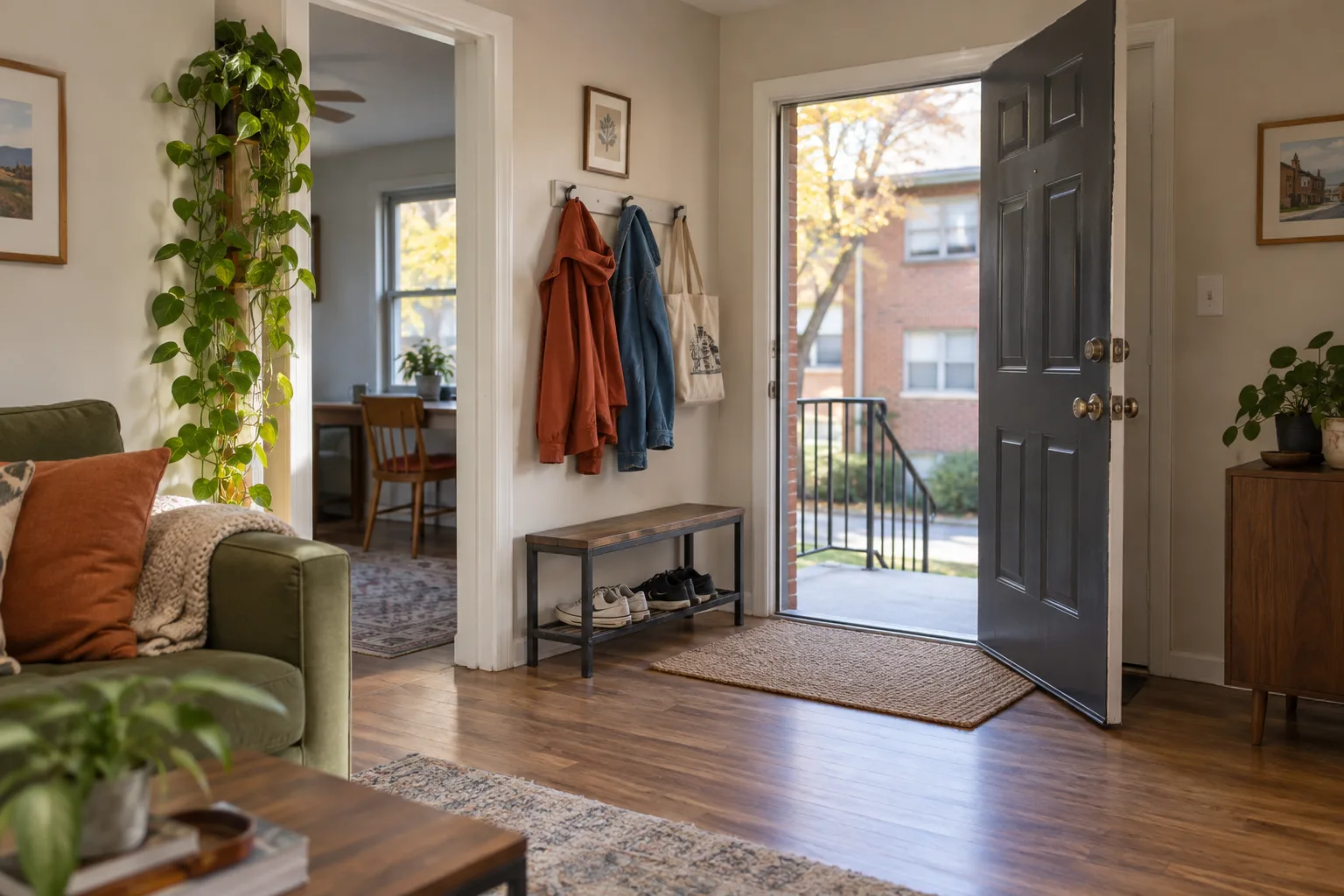
Before putting two chairs on a small porch, open the door all the way. Then walk through carrying the things you normally bring home. The corner that looks empty from the sidewalk may be where a grocery bag swings, a screen door travels, or somebody waits while you find your keys. Outdoor furniture can be small and still occupy the wrong space.
For a U.S. rental, the useful starting point is the kind of outdoor space you actually have. A private ground-floor patio, a shared front porch, and an upper-floor balcony are not interchangeable. This article is about arranging a permitted, usable space around ordinary sitting and circulation. It is not a guide to changing a structure, mounting equipment on a railing, or turning a required exit into another room.
Find the part that belongs to you
Read the lease and building rules before buying. Establish whether the space is private, shared, or part of a common route, and which changes require permission. A door opening onto a porch does not by itself mean that the whole porch is yours to furnish. Likewise, the previous tenant’s arrangement is not reliable evidence that the building permits it.
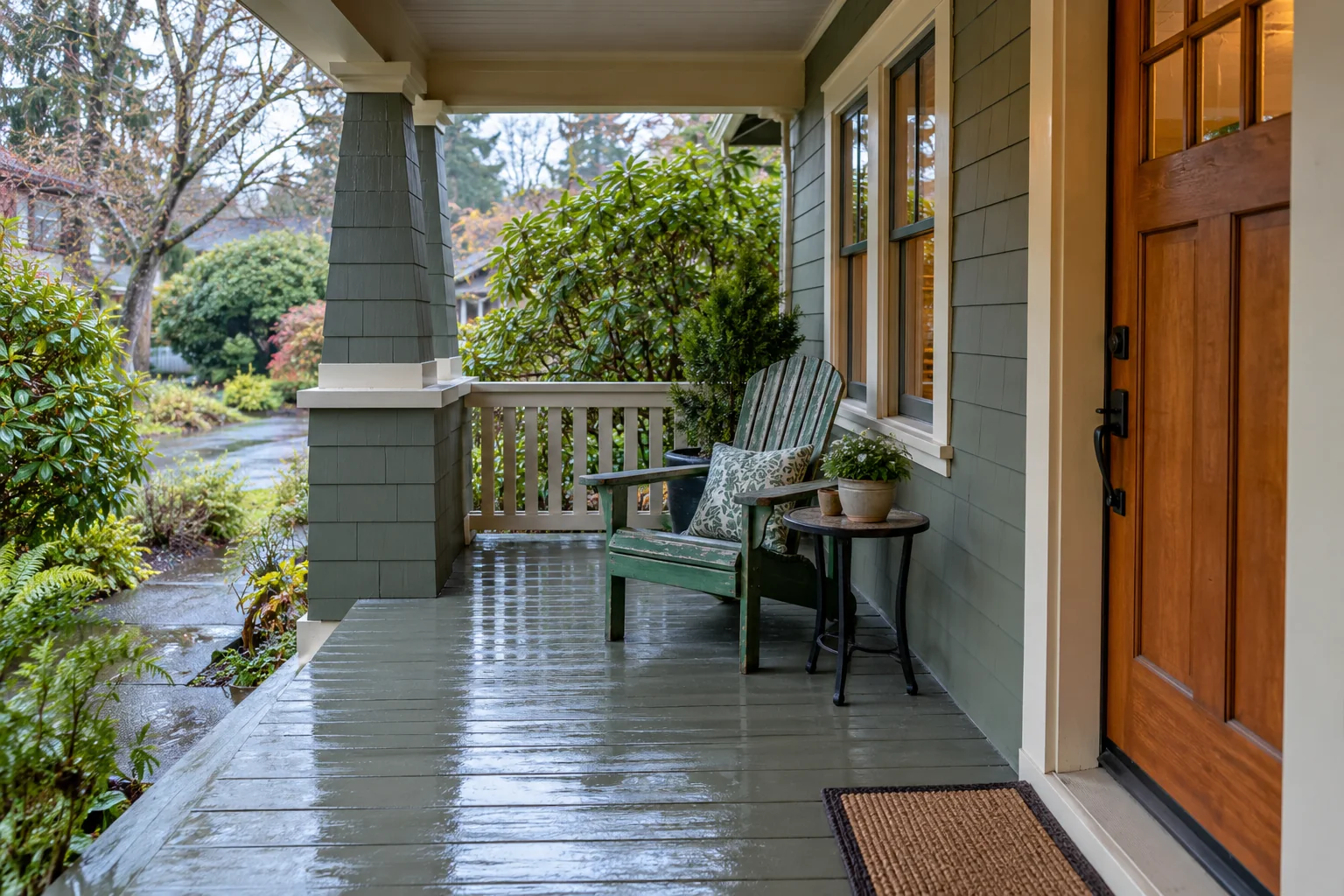
In a hypothetical divided Craftsman house, two apartments share a covered front porch and the steps down to the sidewalk. One household would like a chair beside its door; the other regularly brings a stroller through. The arrangement can work if the sitting area leaves the actual route clear. It fails if the chair is technically outside the doorway but has to be moved every time the stroller passes.
Agree on shared use before objects accumulate. Who moves muddy footwear? Where can a delivery be left without obstructing the route? Does a neighbor need space to pause or turn? These are concrete questions, easier to settle than a broad argument about whether a porch looks tidy. Do not store things on fire escapes or in required exit paths, even temporarily.
Keep safety questions separate from decorating preferences. Grills, open flames, heaters, and electrical equipment need more than a landlord’s casual approval. The U.S. Fire Administration’s outdoor fire guidance covers safe use of outdoor equipment; local fire rules and your building’s restrictions also matter. If you cannot establish that a device is suitable and permitted in the exact location, leave it out of the plan.
A chair, a landing spot, and room for your feet
Choose the activity you want to make possible. Drinking coffee alone needs a comfortable seat and somewhere for a cup. Eating with another person needs a surface that can hold plates and a way for both people to get in and out. A porch that can support one of those uses well may not support both at the same time.
Try a chair you already own for a short, supervised layout test in dry conditions, then bring it back indoors if it is not made for outdoor use. Sit down, stand up, and reach for the imagined table. Measure the occupied arrangement, including your legs. Furniture dimensions rarely tell you how much room a person needs to use the furniture.
An illustrative narrow porch might work with one chair at the closed end and a small table beside it. Adding a second chair opposite could leave nobody enough legroom. A second seat that is brought out only when a guest visits may be more useful than a permanent pair. That solution requires an actual place to store the spare seat; leaning it against the entrance is simply moving the problem.
Be careful with furniture that folds. Folding is helpful when the mechanism is easy for you to operate and the folded item has a home. It is less helpful if the chair is heavy, pinches your fingers, or takes a trip through the entire apartment to put away. Test the full routine rather than buying the word foldable.
Let the weather choose some of the details
Observe the space at the hour you expect to use it. A porch that is shaded before work may be exposed to strong afternoon sun. A roof may stop vertical rain without preventing water from blowing in sideways. Note where water collects and tell management about drainage or structural concerns rather than concealing them under a rug.
Different American settings suggest different questions. On a sheltered Pacific Northwest porch, the issue may be what stays damp between showers. On a sun-exposed Southwestern patio, the seat and table may become uncomfortable at the time you want to sit outside. These are illustrative situations, not promises about regional weather. The conditions at your actual door are more useful than the style of a product photograph.
Avoid creating a daily rescue operation with cushions and loose accessories. If soft seating requires indoor storage, identify that storage first. A sealed-looking box is not automatically suitable for damp fabrics; follow the product’s intended use. Sometimes a seat that can be wiped and used is a better match than one that needs several cushions carried out and back.
Wind changes the calculation for lightweight furniture, umbrellas, screens, and planters. Do not improvise attachments to a railing or assume a heavy container makes a freestanding item secure. Follow manufacturer instructions and building requirements. Where suitable installation cannot be established, choose a simpler arrangement with fewer loose objects and bring permitted items inside when conditions require it.
Privacy does not have to become construction
Before shopping for a tall screen, work out which view bothers you. It may be a direct sightline from a neighboring chair rather than the entire street. Turning your chair slightly or moving it to the other end can alter that view without adding a structure. Try the change while somebody else stands at the relevant viewpoint, with their agreement.
Plants can make a space more pleasant, but large wet containers add weight and smaller ones still need safe placement and drainage. Do not place them where they can fall, obstruct circulation, or drip onto someone else’s space. Ask management about permitted container sizes and locations; structural capacity is not something to estimate from the appearance of a balcony.
Think about the route to water as well. If every watering requires carrying a large container through a carpeted bedroom, a row of thirsty plants becomes a household task. A couple of suitable plants may be easier to enjoy than a dense collection. Local cooperative extension advice can help with plant selection once light, climate, and container conditions are known.
Lighting should serve the route and the intended use without shining into a neighbor’s room. Use products rated for the environment and follow their installation instructions. Avoid trailing cords through doors or across a walking path. An existing building light may already provide what the space needs; any fault in it belongs with management, not an improvised wiring solution.
After the first week, notice what you actually moved. If a table was repeatedly pushed aside, give that movement more weight than the original layout. A successful small porch usually has a generous patch of apparently unused floor. That is the space that lets a person arrive, turn, sit down, and get up again without rearranging the afternoon.