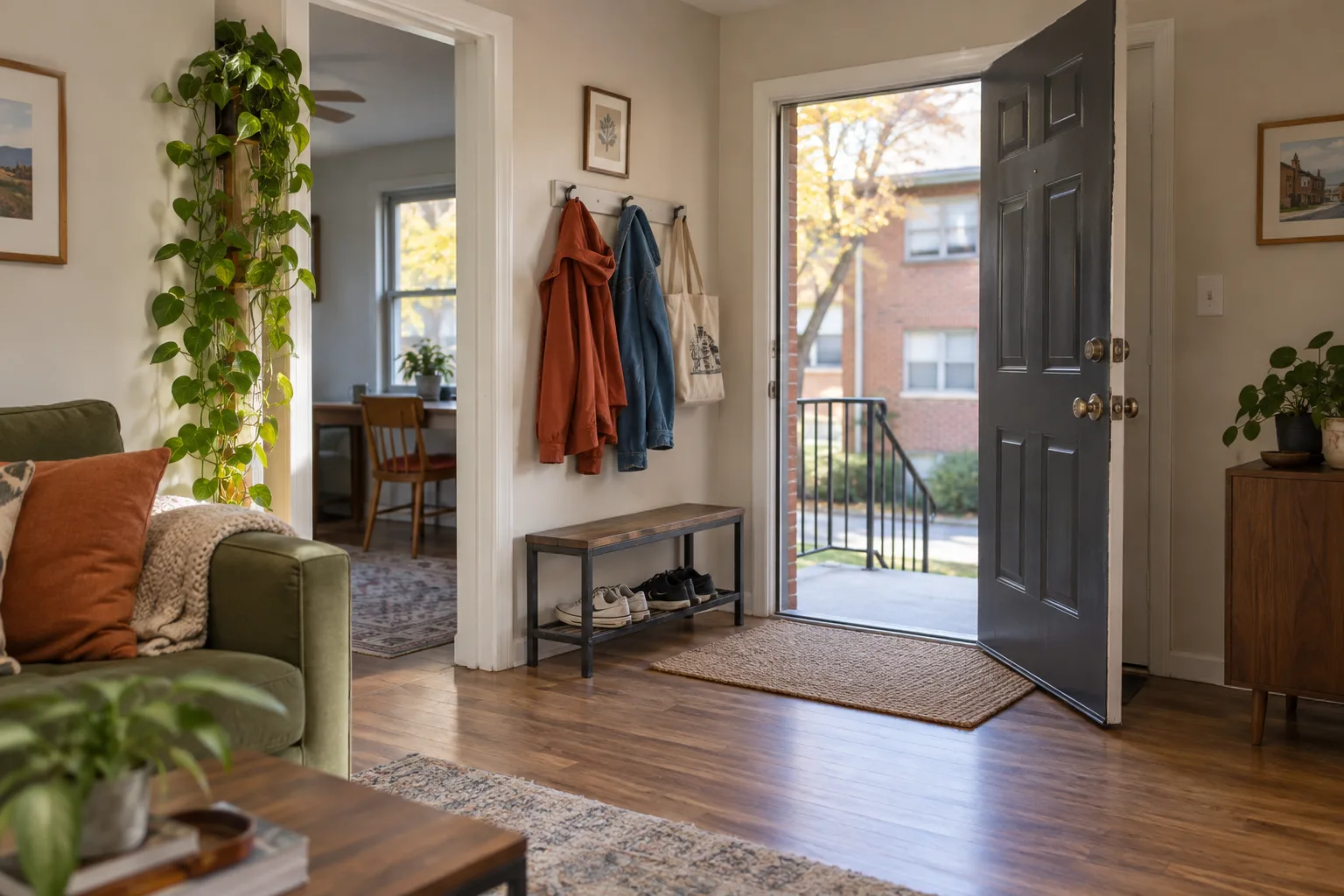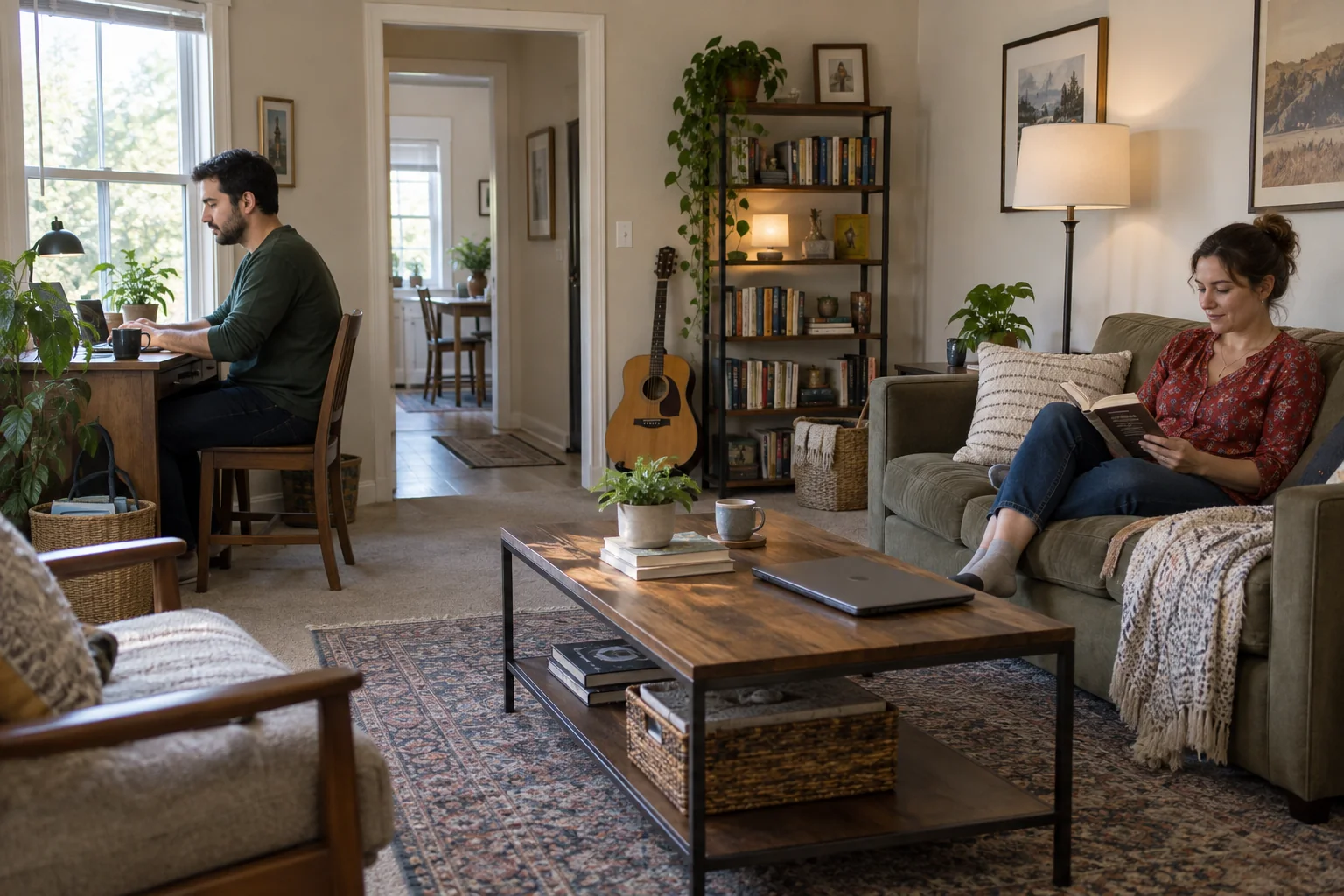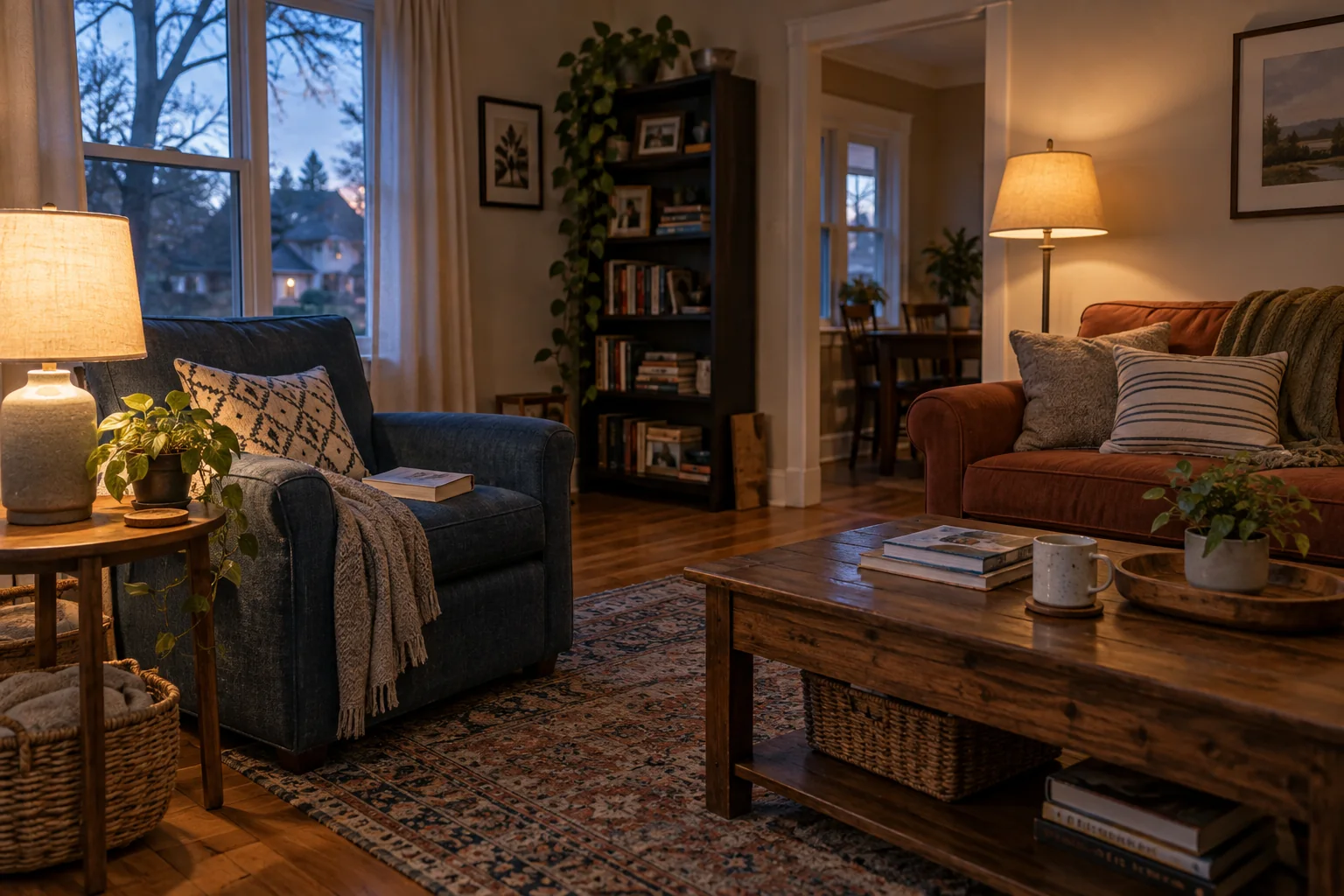
The living room looks fine at noon. By eight, the overhead fixture makes the coffee table bright and leaves the chair where you read in shadow. Turning it off improves the atmosphere but makes finding your glasses a small expedition. This is a placement problem before it is a shopping problem.
Better lighting in a rental usually starts with separating three jobs: seeing your way through the room, seeing what you are doing, and having a comfortable place to sit after the work is done. One ceiling fixture rarely handles all three equally well. You can often improve the balance with lamps you already own, a different bulb, and a little attention to where your eyes are.
Start from the chair, not the ceiling
Wait until the room is normally dark, then sit where you actually spend the evening. A photograph taken from the doorway cannot tell you whether a bare bulb shines into your eyes from the sofa. Open a book, look toward the television, and walk to the kitchen. Notice which problem belongs to which position.
If the page is dim but the room otherwise feels comfortable, try moving a lamp closer to the chair before brightening everything. A shaded lamp beside and slightly behind the seating position may put light on the page without putting the bulb in your direct view. The exact placement depends on the shade, your height, and the chair. Sit down again after moving it.
If you keep walking into a dark corner, that is a different job. A light near that route may be more useful than a stronger reading lamp. Likewise, a bright reflection in the television is unlikely to be solved by adding more light in the same place. Try changing the lamp’s angle or position while the screen is off so the reflection is easy to see.
Do not buy a matching pair merely because the room has two ends. One end might need a focused reading light; the other might need only a soft pool of light on the wall. Matching the tasks matters more than matching the lamps.
Read the bulb box differently
The Department of Energy’s lighting guide distinguishes brightness, measured in lumens, from power consumption, measured in watts. It also explains color temperature: lower Kelvin numbers look warmer, while higher numbers look cooler. Those are separate choices. A warmer-looking bulb is not necessarily a dimmer bulb.
When replacing an LED, note the existing bulb’s lumen output and color temperature before throwing away the packaging. If its brightness is right but the room feels unusually blue at night, experiment with a warmer appearance at a similar output. If the color is pleasant but reading is difficult, consider placement and brightness instead. Changing one thing at a time makes the result easier to judge.
The fixture still has a say. Check its stated limits and the bulb manufacturer’s requirements, including suitability for enclosed fixtures and dimmers. A bulb that fits the socket is not automatically compatible with every enclosure or control. Keep the shade and fitting the manufacturer intended; improvised coverings are not a sensible way to soften the light.
Buy one suitable replacement to try before replacing every bulb in the apartment. The wall color and shade will affect how it looks in the room. Marketing names such as cozy or daylight cannot tell you whether you will enjoy that light beside your particular sofa.
A room can have more than one evening
Consider a hypothetical rental with a ceiling fixture, a sofa against the long wall, and a small dining table near the kitchen. Two people eat there, one sometimes works at the table, and both use the sofa after dinner. Leaving every light on supports the laptop but makes the whole room feel like an extension of the workday.
A more useful arrangement gives the table a task light and places a shaded lamp near the sofa. During dinner, the general light can remain on. During paperwork, the table light can do its specific job. Later, the sofa lamp can remain on while the table is cleared. Nothing in this plan requires a new ceiling fixture or a smart-home account.
The important detail is the switch. If turning off the task light means crawling under the table, the room will keep the wrong light on. Position controls where you can reach them comfortably and follow the equipment instructions. Convenience is part of the lighting plan, not an optional finishing touch.
This is also where two people may want different things. One likes a brighter room; the other dislikes overhead light. Separate controls allow a compromise more precise than alternating between gloom and full illumination. They do not solve every conflict, but they give you something adjustable to discuss.
Let outlets shape the plan
A beautiful lamp in the middle of the room is a poor improvement if its cord crosses the route to the bathroom. Before settling on a position, follow the entire cord to the outlet. Keep walking routes clear, avoid pinching cords under furniture, and do not conceal a damaged cord to make the arrangement look finished. The U.S. Fire Administration’s electrical safety guidance explains cord placement and matching bulbs to fixture ratings.
Prefer a position the lamp’s own cord can serve appropriately. If permanent lighting would require new wiring or a fixture change, involve the landlord and a qualified professional rather than turning a temporary cable arrangement into an installation. A rental-friendly change should be easy to remove and sensible to live around.
Floor lamps also occupy floor space. Test the base beside the chair with somebody sitting down and standing up. An arched lamp can reach over furniture, but its base may demand more room than the photograph suggests. Sometimes the existing side table and a compact table lamp make the more comfortable pair.
In a very small room, avoid solving every dark patch. A bookcase does not need separate illumination simply because it appears dim in a picture. Concentrate on the places you use and the routes between them. Darkness behind an unused cabinet is not a design emergency.
Keep the improvement easy to live with
After several evenings, notice what you switch on without thinking. That is better evidence than whether the arrangement looked impressive immediately after you moved everything. If a lamp stays off because its shade blocks a shelf or its base crowds your feet, reconsider the object or position.
Daylight deserves the same practical attention. A lamp should not make the window awkward to open or take over the only useful space beside it. Try the room in both conditions before buying a larger piece. The best nighttime arrangement still needs to let the apartment work the following morning.
You may end up keeping the overhead light exactly as it is, using it for cleaning and looking for lost things. The change is that it no longer has to do every job. Reading has its own light, the path through the room is clear, and settling onto the sofa no longer begins with a negotiation with the ceiling.