The easiest potluck to attend is one where you know what dinner will be, what you are being asked to bring, and whether showing up empty-handed would make things awkward. Without those answers, a casual invitation can become a small assignment: invent a dish, buy ingredients, find a container, and guess whether somebody else is bringing the same thing.
A neighborhood potluck can share the work of an evening without distributing it equally in every detail. Some people like cooking. Others are coming straight from work, traveling by bus, or managing food restrictions that make a shared meal complicated. The host’s job is to make a workable gathering out of those differences, rather than to pretend that one dish from each person means the effort is automatically fair.
Invite people to an evening, not a catering exercise
Give the invitation a shape. Say when food will be served, roughly when the gathering ends, how many people you expect, and what you are providing. Explain any access details that would affect attending: stairs, available seating, the bathroom location, and whether the event is indoors or outdoors. People should not have to disclose a personal difficulty to discover a basic obstacle.
A useful invitation might offer a few ways to contribute: a side dish, bread, drinks, setup help, or simply attendance. These are examples, not a script everyone has to copy. The point is to make it clear that cooking ability and spending money are not admission requirements. If you genuinely need guests to provide enough food for dinner, be honest about that rather than promising complete freedom and hoping someone brings the main course.
Be explicit about partners, children, and additional guests. A small apartment may have a real capacity limit. Stating it kindly at the outset is easier than trying to fit three unexpected people around a table that already blocks the kitchen door. Likewise, do not describe an event as suitable for children if the space or timing makes that unrealistic.
Coordinate enough to produce a meal
Choose a simple center for the food: perhaps a main dish you provide, with guests choosing sides, or a few agreed substantial dishes. You do not need a spreadsheet with twelve categories. You do need to know that dinner will contain something besides desserts and drinks. Check serving quantities without asking each guest to feed the whole group independently.
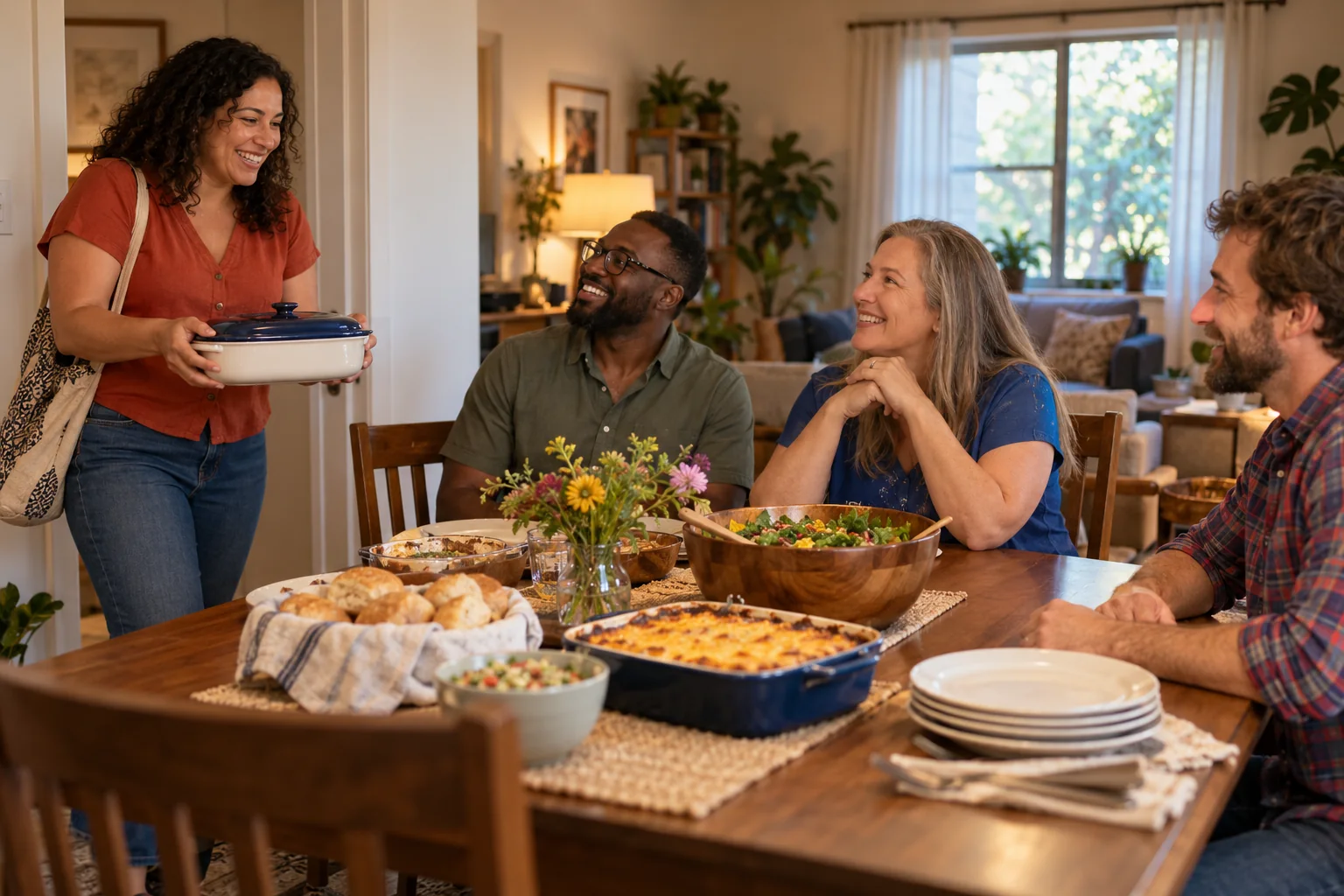
In a hypothetical gathering of eight adults, the host might provide a substantial bean dish and rice, while others bring a salad, bread, fruit, and drinks. Another guest helps arrange chairs. The particular menu is not the recommendation; the distribution is. One person arriving without food does not collapse the meal, and nobody is left guessing whether a small side must somehow become eight full portions.
Ask about oven, refrigerator, and serving needs before the day. Four dishes that all require the oven on arrival create a queue rather than dinner. A guest coming from across town may prefer something that travels easily. Coordinate around the kitchen you have, including the space needed to keep food at a safe temperature, rather than around an imaginary commercial kitchen.
Serving utensils deserve a mention. Ask contributors whether they can bring the utensil their dish needs, and keep a few clean extras available. Give dishes and lids a designated place so the end of the evening does not become a search through unrelated containers. This small bit of organization is more useful than matching table decorations.
Make room for food needs without making promises you cannot keep
Ask guests privately whether there is something they need to discuss about food. Avoid turning the group chat into a public inventory of health information. A person may want to bring their own meal, ask about particular ingredients, or decide that a shared kitchen cannot meet their needs. Those are reasonable responses, not a failure to participate.
Keep ingredient packaging or a written ingredient list available where practical, and identify whose dish it is if a question arises. Do not call a dish allergen-free merely because nobody remembers adding the ingredient. A home potluck cannot casually guarantee the absence of cross-contact. Let the guest explain what information or separation they need, and be candid about what the setting can provide.
The social arrangement matters here. Somebody eating food they brought for themselves should still have a place at the same table and access to the conversation. Do not announce their reason to the group or repeatedly offer other dishes after they have declined. The meal is shared company; the contents of every plate do not have to match.
Offer appealing nonalcoholic drinks without making them a special request. If alcohol is part of the evening, guests still need a way to choose otherwise without explaining themselves. A pitcher of water in reach and a few ordinary alternatives are more useful than a host repeatedly asking who is not drinking and why.
Decide how food will be held, not just when it arrives
Safe transport and serving are part of planning the meal. The USDA’s guidance for self-catered events says perishable food should not remain at room temperature for more than two hours, or one hour above 90°F, unless kept safely hot or cold. It specifies hot holding above 140°F and cold holding below 40°F. Use suitable equipment and a food thermometer rather than judging by how warm a dish feels.
The journey counts in the plan. A casserole brought from another neighborhood has already spent time in transit before it reaches the table. Discuss whether food will arrive ready to serve, safely chilled, or held hot using an appropriate method. Do not assume that putting a lid on a dish controls its temperature.
Serve manageable quantities and keep the remainder safely stored instead of leaving every container out for the whole evening. Designate someone to notice the time and put food away promptly. That person should be able to enjoy the gathering too; a simple plan agreed in advance is easier than asking the busiest host to remember every arrival time while answering the door.
For an outdoor gathering, heat and the absence of refrigeration can change the menu and equipment needed. If the group cannot arrange suitable storage and holding, choose a different format or location. A potluck does not become more relaxed by leaving food safety to chance.
Share the ending as well as the cooking
Set an end time that people can use for transport, care arrangements, and the following morning. Guests can leave earlier without an explanation. A host can also end an evening without waiting until the last person notices the dishes. Saying when the meal finishes is a practical kindness, particularly when neighbors have very different schedules.
Ask for one or two specific cleanup tasks if help would be welcome: clearing the table, washing serving utensils, or returning chairs. Do not silently expect the people who cooked least to compensate by doing all the washing up. Contributions were agreed earlier; the kitchen should not become a place where their value is recalculated.
Handle leftovers while they are still safe to keep, with appropriate containers and prompt refrigeration. Give serving dishes back deliberately rather than creating an indefinite collection at the host’s home. The next morning should not require six messages to reunite a lid with its casserole dish.
If people want another gathering, discuss a format they could actually repeat. Hosting can rotate, but it does not have to move into a home that is unsuitable or unavailable. Somebody can coordinate while another person provides the space. The arrangement is working when people can come, eat, and leave without the invitation becoming a test of domestic competence.